
Circular Economy Forum 2026: From Sustainability to Business Strategy for the New Global Trade Landscape
The circular economy is no longer just about CSR or recycling; it is becoming a business strategy linked to costs, innovation, market access, and competitiveness.


Integrate your CRM with other tools
Lorem ipsum dolor sit amet, consectetur adipiscing elit lobortis arcu enim urna adipiscing praesent velit viverra sit semper lorem eu cursus vel hendrerit elementum morbi curabitur etiam nibh justo, lorem aliquet donec sed sit mi dignissim at ante massa mattis.
- Neque sodales ut etiam sit amet nisl purus non tellus orci ac auctor
- Adipiscing elit ut aliquam purus sit amet viverra suspendisse potenti
- Mauris commodo quis imperdiet massa tincidunt nunc pulvinar
- Adipiscing elit ut aliquam purus sit amet viverra suspendisse potenti
How to connect your integrations to your CRM platform?
Vitae congue eu consequat ac felis placerat vestibulum lectus mauris ultrices cursus sit amet dictum sit amet justo donec enim diam porttitor lacus luctus accumsan tortor posuere praesent tristique magna sit amet purus gravida quis blandit turpis.

Techbit is the next-gen CRM platform designed for modern sales teams
At risus viverra adipiscing at in tellus integer feugiat nisl pretium fusce id velit ut tortor sagittis orci a scelerisque purus semper eget at lectus urna duis convallis. porta nibh venenatis cras sed felis eget neque laoreet suspendisse interdum consectetur libero id faucibus nisl donec pretium vulputate sapien nec sagittis aliquam nunc lobortis mattis aliquam faucibus purus in.
- Neque sodales ut etiam sit amet nisl purus non tellus orci ac auctor
- Adipiscing elit ut aliquam purus sit amet viverra suspendisse potenti venenatis
- Mauris commodo quis imperdiet massa at in tincidunt nunc pulvinar
- Adipiscing elit ut aliquam purus sit amet viverra suspendisse potenti consectetur
Why using the right CRM can make your team close more sales?
Nisi quis eleifend quam adipiscing vitae aliquet bibendum enim facilisis gravida neque. Velit euismod in pellentesque massa placerat volutpat lacus laoreet non curabitur gravida odio aenean sed adipiscing diam donec adipiscing tristique risus. amet est placerat.
“Nisi quis eleifend quam adipiscing vitae aliquet bibendum enim facilisis gravida neque velit euismod in pellentesque massa placerat.”
What other features would you like to see in our product?
Eget lorem dolor sed viverra ipsum nunc aliquet bibendum felis donec et odio pellentesque diam volutpat commodo sed egestas aliquam sem fringilla ut morbi tincidunt augue interdum velit euismod eu tincidunt tortor aliquam nulla facilisi aenean sed adipiscing diam donec adipiscing ut lectus arcu bibendum at varius vel pharetra nibh venenatis cras sed felis eget.
Circular Economy Forum 2026
Promoting the circular economy as a business strategy to meet new global trade regulations

The Story Thailand, in collaboration with the Thai Chamber of Commerce and the Circular Economy Academy by UTCC, hosted the Circular Economy Forum 2026: Sustainability in Action on August 26, 2026, at SCBX NEXT TECH, 4th floor, Siam Paragon. The event provided a platform to exchange perspectives and case studies on implementing the circular economy in the business sector—ranging from resource management, product and packaging design, and waste management, to preparing for environmental regulations that are increasingly shaping trade and competition.
This event builds on a two-year content partnership between The Story Thailand, the Thai Chamber of Commerce, and the Circular Economy Academy by UTCC. The collaboration has documented case studies from seven businesses of various sizes, compiling them into articles and an eBook to serve as a CE Playbook for those interested in the circular economy. The goal is to present the circular economy as something broader than just recycling or resource recovery, integrating it into the core strategies of businesses of all sizes.
Circular Economy: From CSR to Business Competitiveness

Yuthana Jiamtragan, Chairman of the Circular Economy and Environment Committee at the Thai Chamber of Commerce, delivered the opening remarks and a keynote address on "Circular Economy: Future Business Competitive Advantage." He pointed out that sustainability is no longer a CSR activity separate from business operations; it has become a critical factor for competitiveness, market access, and long-term growth. Businesses must integrate environmental, social, and governance (ESG) issues into their strategies and operations across the entire value chain.
Yuthana cited the European Union’s Carbon Border Adjustment Mechanism (CBAM) to illustrate how environmental factors are directly impacting trade costs and competitiveness. Operators who can reduce greenhouse gas emissions will have a cost advantage over those who have not adapted. He also noted that new international regulations, such as the Packaging and Packaging Waste Regulation (PPWR) and the Ecodesign for Sustainable Products Regulation (ESPR), are increasingly linking product design, resource efficiency, and lifecycle responsibility to trade requirements and global market access.
Furthermore, he emphasized that the circular economy is not just about recycling, but about redesigning the entire business system to keep resources in the economy for as long as possible. This approach fosters innovation, reduces waste, and creates economic value alongside environmental stewardship, serving as a key mechanism for the future competitiveness of the Thai business sector.

Dr. Pipat Yodprudtikan, Chairman of Thaipat Institute, introduced the Global Circularity Protocol for Business, a tool released in late 2025 to measure and report material circularity concretely. It divides the scope into Scopes A, B, and C, similar to the GHG Protocol, but shifts the focus from measuring greenhouse gases to managing materials.
The Protocol includes indicators that link the circular economy to business data, such as material productivity and revenue from circular materials. Dr. Pipat applied this data to create a "Return on Circularity" (ROC) metric, demonstrating how investors can compare the returns on circularity between different companies.

Piyachart Isarabhakdi, Chief Sustainomist, BiOST, Institute of Systematic Transformation, presented the "Sustainomy" concept, which bridges sustainability and the economy. He proposed that the business sector and the country shift from a "Quantity of Growth" to a "Quality of Growth" mindset, considering the quality of growth, inclusivity, transition capability, and system resilience, while also prioritizing capacity building to foster readiness from within the organization.
Business sector showcases circular economy from seafood to packaging
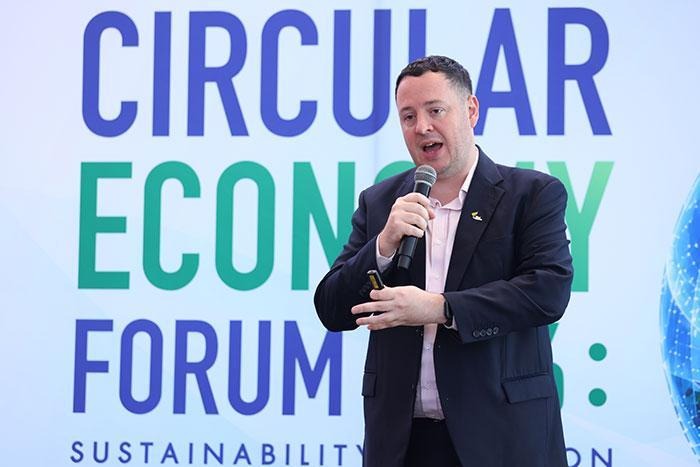
Adam Brennan, Chief Sustainability and Communications Officer, Thai Union Group PCL, presented operations under the SeaChange® strategy. Thai Union aims for five of its large-scale factories to achieve Zero Food Loss, Zero Waste to Landfill, and Zero Wastewater Discharge. He cited examples of maximizing tuna utilization: meat is used for human and pet food, bones are processed into calcium, skin is used for collagen, and fish heads are utilized for oil and Omega-3, thereby increasing raw material efficiency and creating additional business opportunities.
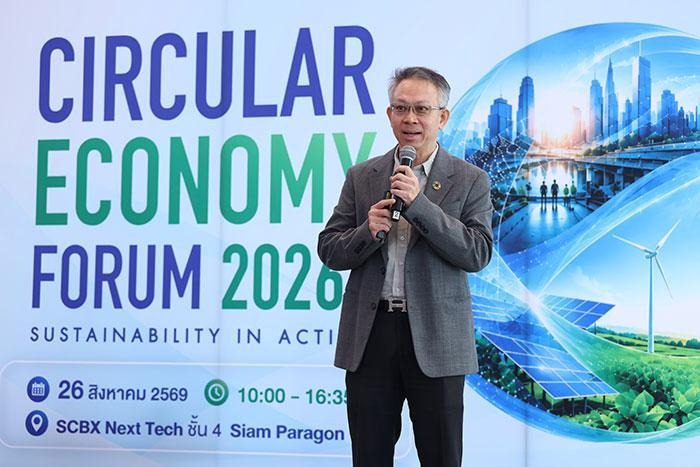
Sunthorn Yongvibulsiri, ESG, Safety and Compliance Director, SCG Packaging PCL (SCGP), presented the use of design and technology to make packaging more resource-efficient. This includes thinning paper boxes while maintaining strength, designing boxes that can be repurposed as displays or toys, and developing mono-materials like Mono PE and Mono PP to make plastic pouches easier to recycle. SCGP also operates over 70 waste paper collection centers nationwide to bring materials back into the production process.
Preparing SMEs for new packaging regulations

Pathompong Deepanya, CEO and Co-founder of DEZPAX, presented the impact of PPWR on businesses, explaining that packaging entering the EU recycling system must account for actual sorting systems, including NIR technology used for material classification. Consequently, material selection and design must go beyond simply labeling packaging as recyclable.
Businesses must also consider reducing unnecessary packaging, utilizing recycled materials, providing clear labeling, and preparing a Declaration of Conformity (DoC) to verify compliance, along with documentation regarding materials and recycled content. Pathompong noted that while these regulations increase complexity, Thailand’s abundance of manufacturers and packaging alternatives provides a strong foundation for businesses to prepare.
TEGH: Connecting waste to energy and new raw materials

Sinineuch Kokanutaporn, Managing Director of Thai Eastern Group Holdings Public Company Limited (TEGH), presented the "Thai Eastern Symbiosis" model, which integrates rubber, palm oil, organic waste management, and renewable energy businesses. By repurposing waste from one process as raw material for another, the company achieves a tangible "Zero Waste, Zero Discharge" outcome.
TEGH has also advanced its organic waste management into "Waste to Bioenergy" using multi-phase digesters and double-stage reactors. Furthermore, the company converts bio-sludge into soil conditioners and uses ash to produce brick blocks. Their commitment to traceability and a low-carbon supply chain is integrated into their efforts to meet regulatory requirements and the demands of both domestic and international clients.
SC Grand: Transforming textile waste into new raw materials
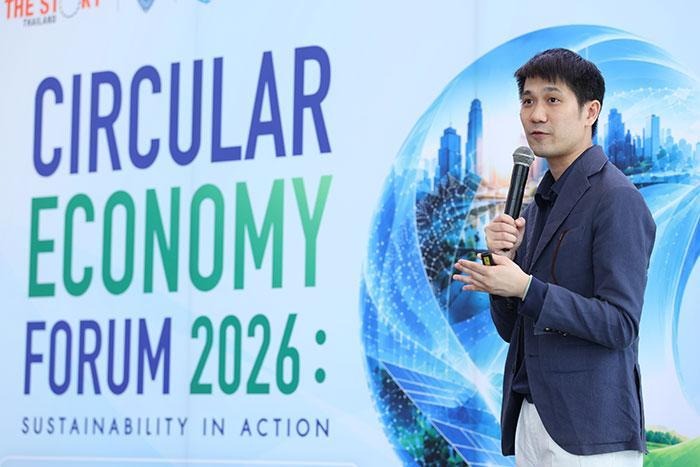
Jiraroj Pojanavaraphan, Managing Director of Sangcharoen Grand Co., Ltd. (SC Grand), demonstrated the process of collecting, sorting, and shredding thread scraps, fabric remnants, and old clothing to spin into new yarn and weave into new fabric. Examples include repurposing old Thai Airways uniforms into new products, as well as collaborations with organizations and brands such as FedEx, Yothaka, and PDM.
The company aims to expand its role as a supply chain partner in Southeast Asia, focusing on connecting textile waste from regional manufacturers with recycling technology and new material production to develop a sustainable textile ecosystem.
Unilever highlights Policy, Infrastructure, and People as drivers of the Circular Economy
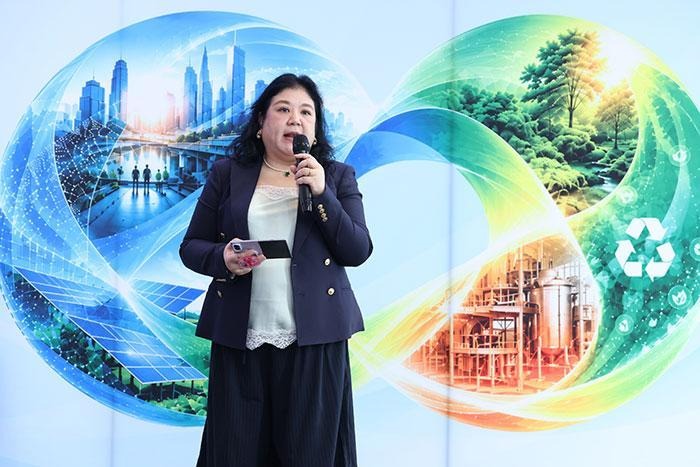
Nattinee Netraumpai, Senior Corporate Communications, Corporate Relations, and Sustainability Advisor at Unilever Thailand, presented the "Closing the Loop" concept, stating that post-consumer materials still hold value and should be returned to the system rather than ending up as waste.
Unilever aims for Net Zero across its entire value chain by 2039, using its Climate Transition Action Plan (CTAP) as a framework for greenhouse gas reduction. The company integrates the circular economy by reducing virgin materials, increasing recycled content, and extending the lifecycle of resources. A key example is Sunlight dishwashing liquid, which uses rPET packaging made from PCR recycled plastic and a biodegradable formula, all while maintaining product performance.
Unilever’s approach to plastic is based on the principles of "Reduce, Circulate, and Collaborate." They emphasize that "recyclable" does not equal "recycled," as designing for recyclability is only the first step; without effective collection, sorting, recycling, and repurposing, the intended cycle cannot be realized. To drive progress at the national level, Unilever advocates for the alignment of policy, infrastructure, and people—calling for clear regulations, efficient collection and sorting systems, and the active participation of consumers, businesses, communities, collectors, and recyclers to ensure materials can truly circulate back into the economy.
Announcement of the "Say No to Single Use Packaging" campaign to reduce single-use waste

Another highlight of the event was the awards ceremony for the short video competition under the "Say No to Single Use Packaging" project. Organized by the Thai Chamber of Commerce’s Circular Economy and Environment Committee, the project was supported by business partners including Nestlé (Thai) Ltd., Charoen Pokphand Group, Central Group, B.Grimm, PTT Public Company Limited, Thai Beverage Public Company Limited, T.C. Pharmaceutical Industries Co., Ltd., and Siam Cement Public Company Limited (SCG), with additional collaboration from CE Academy, the University of the Thai Chamber of Commerce, and The Story Thailand.
The project was launched to raise awareness and encourage changes in packaging consumption habits through the creative power of the business sector, the public, and the younger generation. It focuses on communicating the importance of reducing, reusing, recycling, and choosing environmentally friendly packaging—a vital starting point for resource efficiency and the practical implementation of a circular economy.
The competition provided an opportunity for entrepreneurs, organizations, and students to present their ideas through short videos, reflecting the role of all sectors in reducing single-use packaging waste. It aims to foster a consumption culture that values resources throughout the product lifecycle, in line with the circular economy concept, which prioritizes keeping resources in the economic system for as long as possible rather than simply managing waste at the end of its life.
Submissions were evaluated based on four key criteria: content and storytelling aligned with circular economy principles, creativity, the ability to engage and drive behavioral change, and production quality. While 20 finalists were originally planned, a tie for the final spot resulted in 21 entries advancing to the final round, all of which received certificates of recognition.
The competition results are as follows: The winner is Ms. Supitchaya Saenpanya from Khlong Bang Krathuek School, who also received the Popular Vote award based on public engagement through views, likes, shares, and comments on designated channels. Meanwhile, the first runner-up is Mr. Kiattisak Singngam from Visualize Media Innovation Co., Ltd., and the second runner-up is Ms. Piyachat Thomya from Benjamarachalai School under the Royal Patronage.
The “Say No to Single Use Packaging” project demonstrates that driving a circular economy is not just about business or technology; it requires understanding and participation from all sectors to shift production and consumption habits. Together, we can build a system that uses resources efficiently, minimizes waste, and creates long-term sustainable value for society and the environment.
The Circular Economy Forum 2026: Sustainability in Action brings together policy perspectives, measurement tools, cross-industry case studies, and interactive activities for businesses, the public, and youth. It showcases how to implement circular economy practices—from resource reduction, product design, and waste management to recovery systems and preparing for evolving trade regulations. Scaling the circular economy requires collaboration across the government, private sector, and the entire supply chain to make resource circulation a reality.


