
Double Day 2026: Insights into SEA consumer behavior and strategies for 9.9–12.12.
Analyzing Double Day 2026 behavior in SEA and Thailand: From 9.9 and 11.11 to 12.12, as consumers plan for deals, here are the strategies brands need to know.

Integrate your CRM with other tools
Lorem ipsum dolor sit amet, consectetur adipiscing elit lobortis arcu enim urna adipiscing praesent velit viverra sit semper lorem eu cursus vel hendrerit elementum morbi curabitur etiam nibh justo, lorem aliquet donec sed sit mi dignissim at ante massa mattis.
- Neque sodales ut etiam sit amet nisl purus non tellus orci ac auctor
- Adipiscing elit ut aliquam purus sit amet viverra suspendisse potenti
- Mauris commodo quis imperdiet massa tincidunt nunc pulvinar
- Adipiscing elit ut aliquam purus sit amet viverra suspendisse potenti
How to connect your integrations to your CRM platform?
Vitae congue eu consequat ac felis placerat vestibulum lectus mauris ultrices cursus sit amet dictum sit amet justo donec enim diam porttitor lacus luctus accumsan tortor posuere praesent tristique magna sit amet purus gravida quis blandit turpis.

Techbit is the next-gen CRM platform designed for modern sales teams
At risus viverra adipiscing at in tellus integer feugiat nisl pretium fusce id velit ut tortor sagittis orci a scelerisque purus semper eget at lectus urna duis convallis. porta nibh venenatis cras sed felis eget neque laoreet suspendisse interdum consectetur libero id faucibus nisl donec pretium vulputate sapien nec sagittis aliquam nunc lobortis mattis aliquam faucibus purus in.
- Neque sodales ut etiam sit amet nisl purus non tellus orci ac auctor
- Adipiscing elit ut aliquam purus sit amet viverra suspendisse potenti venenatis
- Mauris commodo quis imperdiet massa at in tincidunt nunc pulvinar
- Adipiscing elit ut aliquam purus sit amet viverra suspendisse potenti consectetur
Why using the right CRM can make your team close more sales?
Nisi quis eleifend quam adipiscing vitae aliquet bibendum enim facilisis gravida neque. Velit euismod in pellentesque massa placerat volutpat lacus laoreet non curabitur gravida odio aenean sed adipiscing diam donec adipiscing tristique risus. amet est placerat.
“Nisi quis eleifend quam adipiscing vitae aliquet bibendum enim facilisis gravida neque velit euismod in pellentesque massa placerat.”
What other features would you like to see in our product?
Eget lorem dolor sed viverra ipsum nunc aliquet bibendum felis donec et odio pellentesque diam volutpat commodo sed egestas aliquam sem fringilla ut morbi tincidunt augue interdum velit euismod eu tincidunt tortor aliquam nulla facilisi aenean sed adipiscing diam donec adipiscing ut lectus arcu bibendum at varius vel pharetra nibh venenatis cras sed felis eget.
Double Day 2026: From discount days to "Planned Shopping Days," as SEA consumers wait for the best value before buying.
From 6.6, 7.7, and 8.8 to 9.9, 11.11, and 12.12, Double Day campaigns have been a staple of the Southeast Asian e-commerce calendar for years.
Initially, the key selling point of these days was "urgency"—whether through flash sales, limited-time vouchers, or countdowns designed to make consumers feel they had to buy immediately or miss out.
However, recent consumer behavior data paints a different, more compelling picture.
Many consumers aren't waiting for Double Day because they suddenly feel the urge to shop; they already know what they want and choose to delay their purchase until the day they expect the best deal.
Double Day is shifting from an impulse shopping moment to a planned shopping moment.
In 2026, as consumers across Southeast Asia become more cautious with their spending, understanding this "wait for value" behavior may be more important for brands than simply competing on who has the deepest discount.
Consumers in 2026 haven't stopped spending, but they are "thinking more before they buy."
A Milieu Insight survey of 3,000 consumers in April 2026 across Singapore, Thailand, Malaysia, Indonesia, Vietnam, and the Philippines found that 54% describe their spending behavior as "spending wisely," while 53% stated they would be more cautious with spending over the next three months, compared to 32% in 2025.
What consumers want isn't just a "low price," but the feeling that their money is well spent.
71% still cite the best price as a key factor in choosing products, and 58% say promotions influenced their spending in the past month. However, when it comes to long-term brand relationships, more important factors are "worth the money" (53%) and consistent quality (51%).
This aligns with what NIQ has observed in the Asia Pacific region: consumers are redefining "value" by prioritizing quality, price transparency, and relevance to their actual needs over responding to generic promotions.
This gives Double Day in 2026 a different set of challenges.
Promotions are still important, but they must make consumers feel that "this is the right time to buy."
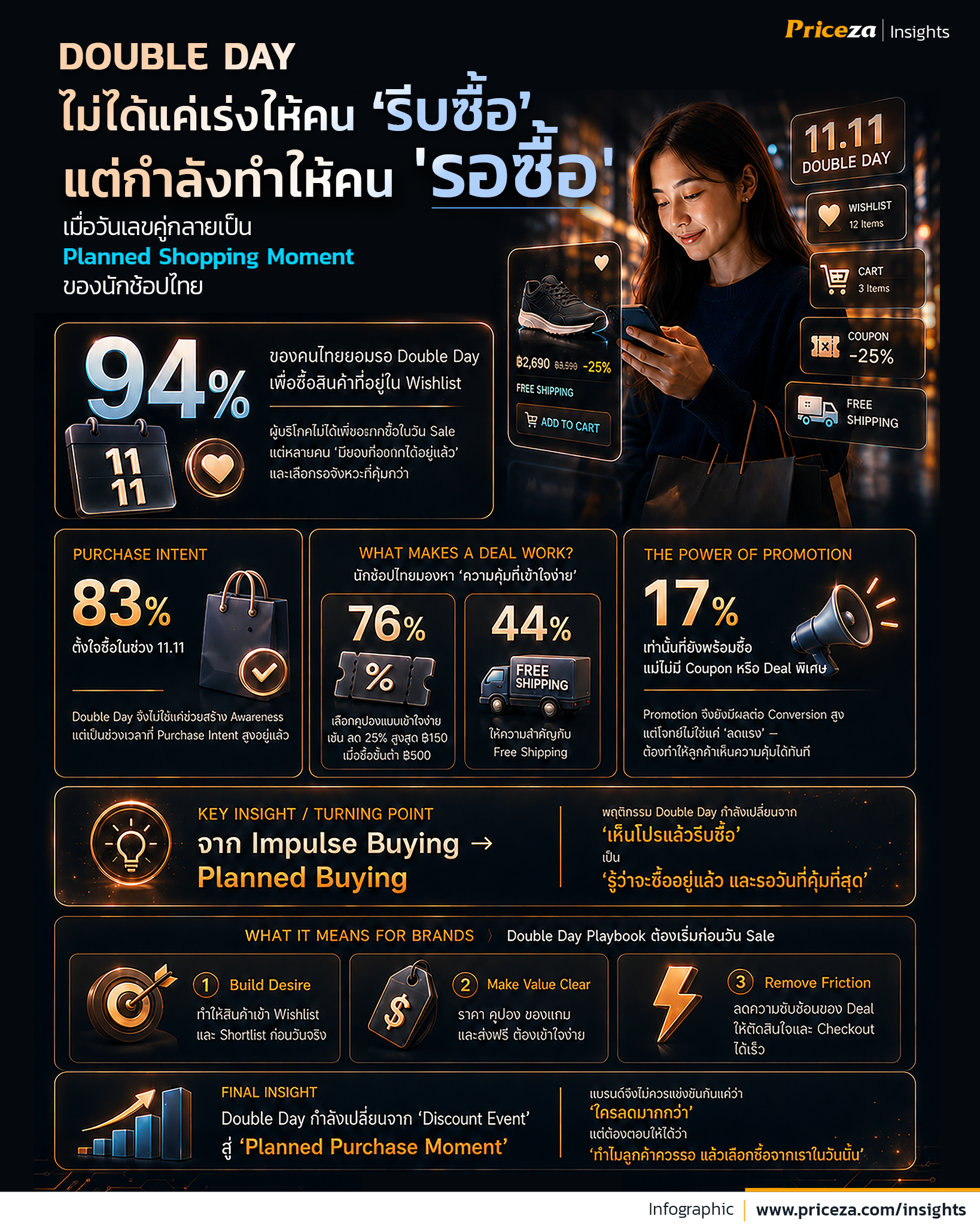
94% of Thais are willing to wait for Double Day to buy the items they want.
A Milieu Insight study on Double Day, which surveyed over 6,000 consumers across six Southeast Asian countries, found that all respondents are now familiar with Double Day campaigns, indicating that building awareness for these "double-digit days" is no longer the primary challenge.
But the more interesting data point is the "waiting" behavior.
In Thailand, 94% of respondents stated they are willing to wait for Double Day to purchase items already on their wishlist, the highest among the six countries, followed by Vietnam and the Philippines at 92%.
This behavior is even more pronounced for high-ticket items, with nearly 8 out of 10 respondents in many markets saying they are willing to wait for a mega sale to purchase big-ticket items like electronics or furniture.
This marks a major turning point for Double Day sales.
Consumers are no longer just asking,
“What’s on sale today?”
แต่กำลังถามว่า
“Should I wait for Double Day to buy this?”
Therefore, modern FOMO isn't necessarily driven by impulsive desire, but by consumers who already know what they want and are waiting for a “trigger” that signals the perfect time to checkout.
11.11 clearly reflects that “urgency” is evolving into “planned urgency.”
Milieu’s 11.11 survey of over 3,000 consumers across six SEA markets further reinforces this behavior.
Purchase intent during 11.11 is high across almost every market, with Vietnam leading at 94%, followed by the Philippines at 92%, Indonesia at 89%, Malaysia at 88%, Thailand at 83%, and Singapore at 77%.
But what’s interesting is that consumers aren’t “rushing” in the traditional sense.
In many markets, a large number of consumers say they wait for Double Day to purchase high-ticket items, including 95% in Vietnam, 91% in the Philippines, 86% in Malaysia, 85% in Singapore, and 80% in Indonesia.
Milieu calls this behavior Strategic Urgency
In other words, consumers aren’t rushing because they just discovered a product; they are preparing in advance and making their decision once the deal, price, and timing align.
For brands, this means campaigns shouldn't just kick off at midnight on 11.11.
The period leading up to Double Day may be just as important as the sale day itself.
Because this is when consumers are comparing, saving, adding to cart, and deciding which brand gets their money once the promotion begins.
For Thai consumers, “simple, straightforward value” is key.
Looking specifically at Thailand, it’s clear that consumers aren’t looking for the most complex promotions, but rather responding to benefits that are easy to understand at a glance.
According to Milieu’s 11.11 data:
- 70% participate because they see it as the “biggest discount of the year.”
- 44% prioritize the number of participating stores.
- 44% prioritize better free shipping conditions.
When asked to choose only one type of coupon, 76% opted for a 25% discount, capped at 150 THB, with a minimum purchase of 500 THB. Meanwhile, without any coupons or special deals, only about 17% would still be ready to purchase.
This figure does not mean every brand should use the same coupon formula, as each business has different margins, price points, and basket sizes.
However, the key insight is:
Deals must allow consumers to quickly calculate their value.
If customers have to read through multiple vouchers, compare complex terms, or are unsure of the final price, that complexity can become friction that hinders the behavior of Double Day shoppers, who are already prepared to make a decision.
Double Day isn't just a game for Gen Z.
Another very interesting insight for the Thai market is that the group with the highest purchase intent during 11.11 is not the youngest demographic.
Milieu found that Thai consumers aged 45 and older have a purchase intent of approximately 91%, while the 16–24 age group sits at about 77%, a difference of 14 percentage points.
And behavior varies by age group.
Older age groups place more importance on free shipping, while consumers aged 25–34 respond more strongly to creator influence than other groups in this dataset. Meanwhile, BNPL (Buy Now, Pay Later) carries more weight among Millennials.
This suggests that using the same creative, the same promotion, and the same message for every group may not be the most effective strategy.
Brands may need to shift from:
One Campaign for Everyone
to:
One Campaign, Multiple Purchase Motivations
From Discounts to Live + Affiliate + Trust
There is another significant change in Double Day: purchase decisions are no longer driven solely by vouchers.
NIQ data from the 12.12 Mega Sales in Indonesia, which surveyed 1,016 internet users across 41 cities, found that online sales during the Mega Sales reached IDR 31.2 trillion, with daily transactions 6.6 times
But the behavior behind these sales figures is even more interesting.
78% of respondents identified Live Shopping as a preferred feature, while 51% are shopping via live streams more frequently, and 44% spend more on Live Shopping than through traditional purchasing methods.
Meanwhile, 50% have made purchases via Affiliate Links, with the primary drivers being not just discounts, but also product quality, price, reviews, and trust in influencers.
This data is Indonesia-specific and should not be directly applied to consumer behavior in SEA or Thailand, but it effectively reflects the direction of Mega Sales in that:
Discounts provide a reason to buy, but content and trust help give consumers the confidence to make the purchase.
Double Day events are increasingly becoming integrated with the world of creator commerce.
Double Day is evolving into a “Media Season” rather than just a sales day.
Data from Sensor Tower in the State of Digital Advertising in Southeast Asia 2026 report also indicates that 9.9, 11.11, and 12.12 have become seasonal moments that influence advertiser activity, campaign timing, and category demand across the region.
In the digital advertising market tracked by Sensor Tower, SEA is projected to reach approximately 3.6 trillion digital ad impressions in 2026 and over US$3 billion in digital ad spend, with shopping being one of the largest categories in the digital advertising market.
This means Double Day is no longer just a competition at the checkout stage.
It is a competition across:
Attention → Consideration → Cart Building → Conversion
which begins days or even weeks before the actual double-digit date.
5 things brands should adjust for Double Day 2026
Based on all this data, Priceza Insights believes that the Double Day strategy in 2026 should shift from “heavy discounts on the day” to designing a journey that begins well before the sale date.
1. Build demand before building urgency
If consumers are already preparing their wishlists and waiting to buy, brands should ensure their products are on those shortlists before the campaign day.
Pre-sale content, product reviews, comparisons, creator content, and add-to-cart campaigns are therefore not just awareness activities, but essential parts of a conversion strategy.
2. Make the “value” understandable in seconds
Instead of stacking multiple layers of vouchers, brands should make it immediately clear to consumers:
What the final price is / How much they need to buy / Whether shipping is free / What extra perks they get
Because on days when every brand is slashing prices, “ease of understanding the deal” can become a competitive advantage.
3. Don’t view Double Day as a campaign only for the younger generation.
Data from Thailand shows that the 45+ age group has a very high purchase intent during 11.11.
Segmentation should therefore be based on age, category, purchase motivation, and payment preference, rather than using the same creative for every consumer group.
4. Use creators as “deal explainers,” not just code distributors.
As deals become more complex, creators can help explain who a product is for, which model offers better value, how to use coupons, or which bundle to buy.
The role shifts from
“Here is my discount code.”
to:
“Here is why this deal is right for you.”
which bridges content, trust, and affiliate conversion together.
5. Measure more than just GMV.
Mega sales can generate massive revenue, but brands should look further to see if those sales are actually creating business value.
Beyond GMV, you should track metrics such as
AOV, contribution margin, new customers, coupon costs, affiliate costs, paid media costs, repeat purchases, and incremental revenue.
Because if every brand competes with discounts simultaneously, selling more doesn't always mean making more profit.
Double Day is still important, but the rules of the game are changing.
Double Day is not losing its relevance. On the contrary, data on both consumer behavior and advertising activity shows that these double-digit dates are firmly embedded in Southeast Asian e-commerce habits.
But what has changed is the reason why people buy.
Consumers are no longer just triggered by a countdown to rush a purchase; they have learned the e-commerce calendar, know when to wait, recognize what constitutes a good deal, and are more prepared to compare before checking out.
Therefore, the Double Day competition in 2026 may not be decided at the stroke of midnight on 9.9, 11.11, or 12.12.
The game might start the moment a consumer thinks,
“I’m going to buy this, but I’ll wait for the Double Day sale.”
Brands that can get onto a consumer’s wishlist before the sale date, make the value proposition immediately clear, reduce checkout friction, and use content and creators to validate the decision will have a significant advantage over brands that rely solely on competing with discounts on the final day.
Priceza Insights View
Double Day is shifting from a “Discount Event” to a “Planned Purchase Moment.”
In an era where consumers are more cautious with their spending, promotions can still grab attention, but brands must do more than just slash prices.
The new challenge is to clearly establish Perceived Value well before the sale date, helping consumers understand why an item belongs on their wishlist and why “today” is the perfect time to check out.
Thus, the new Double Day playbook can be summarized as:
Build Desire before the sale → Make Value Clear → Remove Friction → Reinforce Trust → Convert at the Right Moment
Because a great mega sale shouldn’t just make customers “want to buy quickly.”
It should make them feel that:
“This is the most rewarding moment to buy what I’ve already been wanting.”
FAQ
What is Double Day?
Double Day is an e-commerce campaign featuring dates where the month and day match, such as 6.6, 7.7, 8.8, 9.9, 10.10, 11.11, and 12.12. Marketplaces and brands typically run promotions like discounts, vouchers, free shipping, flash sales, and live commerce to boost sales.
Are 11.11 and 12.12 still important in 2026?
They remain important. The 2026 Sensor Tower report still classifies 9.9, 11.11, and 12.12 as seasonal shopping moments that influence advertising activity and campaign timing in Southeast Asia, while consumer surveys continue to show high purchase intent across many markets.
Do Thai people really wait for Double Day to shop?
The 2025 Double Day survey by Milieu Insight found that 94% of respondents in Thailand are willing to wait for Double Day to purchase items on their wishlist, the highest proportion among the six countries surveyed.
What types of promotions attract Thai consumers during Double Day sales?
Milieu’s 11.11 data reveals that 70% of consumers are drawn to the "biggest discount of the year," while 44% prioritize free shipping. When asked to choose a preferred coupon type, 76% opted for percentage-based discounts with clear minimum spend and cap requirements.
When should brands launch their Double Day campaigns?
Since consumers tend to plan ahead and wait for these dates to make purchases, brands shouldn't wait until the actual Double Day to start their campaigns. Instead, they should use the preceding period to drive product discovery, reviews, wishlisting, and add-to-cart actions, ensuring their products are in the consideration set before the promotional competition intensifies.
Data Note: The Double Day and 11.11 figures in this article are based on a 2025 Milieu Insight survey, while the context regarding SEA consumer spending and advertising data uses 2026 figures to analyze trends for Double Day 2026. Therefore, the 2025 data should be used as a behavioral benchmark rather than a direct projection of 2026 campaign results.


