When Creator Content Acts as the "New Storefront" for Tech Retail: Decoding the BaNANA Affiliate Strategy
A deep dive into the BaNANA Affiliate case study: How creator content acts as a new storefront for tech retail, generating demand and connecting it to products, traffic, and transactions through affiliate marketing in an omnichannel commerce journey.

Integrate your CRM with other tools
Lorem ipsum dolor sit amet, consectetur adipiscing elit lobortis arcu enim urna adipiscing praesent velit viverra sit semper lorem eu cursus vel hendrerit elementum morbi curabitur etiam nibh justo, lorem aliquet donec sed sit mi dignissim at ante massa mattis.
- Neque sodales ut etiam sit amet nisl purus non tellus orci ac auctor
- Adipiscing elit ut aliquam purus sit amet viverra suspendisse potenti
- Mauris commodo quis imperdiet massa tincidunt nunc pulvinar
- Adipiscing elit ut aliquam purus sit amet viverra suspendisse potenti
How to connect your integrations to your CRM platform?
Vitae congue eu consequat ac felis placerat vestibulum lectus mauris ultrices cursus sit amet dictum sit amet justo donec enim diam porttitor lacus luctus accumsan tortor posuere praesent tristique magna sit amet purus gravida quis blandit turpis.

Techbit is the next-gen CRM platform designed for modern sales teams
At risus viverra adipiscing at in tellus integer feugiat nisl pretium fusce id velit ut tortor sagittis orci a scelerisque purus semper eget at lectus urna duis convallis. porta nibh venenatis cras sed felis eget neque laoreet suspendisse interdum consectetur libero id faucibus nisl donec pretium vulputate sapien nec sagittis aliquam nunc lobortis mattis aliquam faucibus purus in.
- Neque sodales ut etiam sit amet nisl purus non tellus orci ac auctor
- Adipiscing elit ut aliquam purus sit amet viverra suspendisse potenti venenatis
- Mauris commodo quis imperdiet massa at in tincidunt nunc pulvinar
- Adipiscing elit ut aliquam purus sit amet viverra suspendisse potenti consectetur
Why using the right CRM can make your team close more sales?
Nisi quis eleifend quam adipiscing vitae aliquet bibendum enim facilisis gravida neque. Velit euismod in pellentesque massa placerat volutpat lacus laoreet non curabitur gravida odio aenean sed adipiscing diam donec adipiscing tristique risus. amet est placerat.
“Nisi quis eleifend quam adipiscing vitae aliquet bibendum enim facilisis gravida neque velit euismod in pellentesque massa placerat.”
What other features would you like to see in our product?
Eget lorem dolor sed viverra ipsum nunc aliquet bibendum felis donec et odio pellentesque diam volutpat commodo sed egestas aliquam sem fringilla ut morbi tincidunt augue interdum velit euismod eu tincidunt tortor aliquam nulla facilisi aenean sed adipiscing diam donec adipiscing ut lectus arcu bibendum at varius vel pharetra nibh venenatis cras sed felis eget.
When creator content acts as a new storefront for tech retail: Unpacking the BaNANA Affiliate strategy
Affiliate marketing is the mechanism that connects demand from tech reviews and recommendations to a measurable commerce journey, spanning both online and physical stores.
When discussing creators in the tech retail business, the role of reviews, unboxing, comparisons, and hands-on testing is nothing new. This content has long helped translate complex specs and features into easy-to-understand information, playing a key role in both sparking interest and driving consumer purchasing decisions.
What makes BaNANA Affiliate interesting isn't that creators are just now influencing commerce, but rather the addition of an affiliate layer that connects the existing role of creators to measurable products, traffic, and transactions.
In this light, creator content can function as a “new storefront” for tech retail because it is a primary touchpoint where consumers discover products, learn, compare, and begin to form purchase intent before choosing the channel that best suits them. Meanwhile, affiliate marketing connects the demand generated by content to the commerce journey through trackable touchpoints.
For products like smartphones, notebooks, gaming devices, or gadgets, the journey is rarely linear. A consumer might watch a review, check prices and specs on a website, walk into a store to test the product, and then return to buy it online or choose Click & Collect. Conversely, another person might complete the transaction at a physical store the very first time they go to test the product.
Therefore, this case is not about choosing between creators or affiliate marketing, but rather the synergy of three layers:
Creators generate demand → Affiliate marketing connects demand to measurable commerce → Omnichannel retail supports closing the journey through the consumer's preferred channel.
When creator content acts as another “storefront” for tech retail
For technology products, the buying process often begins long before a consumer visits a retailer's website. A gaming creator might introduce someone to a device for the first time, a tech reviewer might explain how a new model differs from the previous one, or comparison content might help someone narrow down their choices to just two or three models.
Data referenced in this case, based on a survey of 2,400 consumers across 6 Southeast Asian markets, found that 67% have purchased a product because a creator recommended it, and 49% of affiliate purchases are driven by trust and validation. This reflects that even as discovery channels expand through marketplaces, search, or generative AI, recommendations from trusted sources still play a vital role in validating purchasing decisions.
For tech products, this role is even more critical because consumers don't just want to know that a product is available; they want to reduce uncertainty before making a decision. Creators can act as both a demand trigger that brings a product into the consideration set and a decision enabler that helps answer whether the product is truly suitable for the buyer's needs.
By adding an affiliate layer, this content can connect more directly to products and trackable commerce journeys.

From creator content to an omnichannel commerce journey
What makes the BaNANA case different from pure e-commerce is that after a creator generates interest, the consumer doesn't necessarily have to go straight from an affiliate link to checkout.
BaNANA already has a retail structure that supports diverse journeys, including a network of over 600 branches across 77 provinces, BNN.in.th, and Click & Collect services, allowing consumers to move between online and physical stores according to their own needs.
The commerce journey can therefore take many forms simultaneously. Someone who watches a creator review might click through to BNN.in.th and buy immediately, which is an online conversion that affiliate tracking can clearly attribute to the partner. Meanwhile, others might visit a product page to check prices and promotions before walking into a store to test the product and buy it there. Some might even test a product in-store, return to watch more reviews to confirm their decision, and then come back to order online.
พฤติกรรมเหล่านี้สะท้อนทั้ง Webrooming หรือ Research Online ก่อนซื้อ Offline และ Showrooming หรือดูสินค้าจริงที่ Store ก่อนกลับไปซื้อ Online ซึ่งมีความสำคัญเป็นพิเศษกับสินค้าที่มีราคาสูงและต้องการประสบการณ์จริงก่อนตัดสินใจ
This elevates the role of creator content beyond just being a "link to drive online sales." Creators can engage consumers before they enter a store, during the comparison phase, or even after they have tested a product, right before they finalize their purchase through another channel.

How does affiliate marketing turn creator commerce into something measurable?
Creators can build interest, product desire, and influence decisions before a consumer even visits a website or store. What affiliate marketing adds is a trackable commerce path that connects content to products, allowing brands to gain clearer visibility into the performance of specific parts of the journey.
When a creator's review or recommendation includes an affiliate link, the path can flow from content → click → product visit → online transaction, and the system can attribute that traffic and order back to the specific partner or content.
This is where affiliate marketing shifts creator activity from being measured solely by views and engagement to incorporating metrics like clicks, transactions, conversions, and sales contribution.
Simply put:
Creators build demand;
affiliate marketing connects that demand to measurable commerce.
Of course, a creator's influence may be broader than what affiliate tracking can capture. If a consumer watches a review and then walks into a store to buy offline without an offline attribution system in place, that transaction might not be directly credited to the affiliate.
Therefore, the role of affiliate marketing isn't to "measure every influence," but to ensure that the parts of the journey passing through trackable touchpoints can be measured more clearly.
This is why affiliate marketing doesn't replace omnichannel; it acts as a measurable commerce layer within the omnichannel journey.
Creator Content as a Distributed Storefront for Tech Retail
Viewing creator content as a "new storefront" doesn't mean creators are replacing BaNANA stores or BNN.in.th. Instead, it means retailers have more commerce touchpoints in the spaces where consumers are already spending time, researching information, and forming their needs.
Physical stores still perform functions that content cannot fully replace, such as allowing customers to touch and test products, consult with staff, or pick up items. Meanwhile, creator content offers a contextual advantage, as the same product can be presented through various angles that resonate with different communities and purchase intents.
Gaming content can build desire for gaming devices, tech reviews can answer questions regarding product expertise, recommendation content can assist consumers during the consideration phase, and deal content can act as a purchase trigger when the consumer is ready to buy.
When this content is connected with affiliate links, each creator is no longer just "media placement" but acts as a distributed storefront that brings an audience from their own context into the BaNANA product ecosystem, allowing the trackable parts of the journey to be linked back to performance.
The work, therefore, doesn't start with the question, "Which creator has the highest reach?" but shifts toward matching product × creator expertise × audience intent more effectively, as a creator with a smaller audience may generate more value in certain categories if their viewers are in the consideration stage and the content is highly relevant to the product.

3 Strategic Plays that make creator commerce meaningful for tech retail
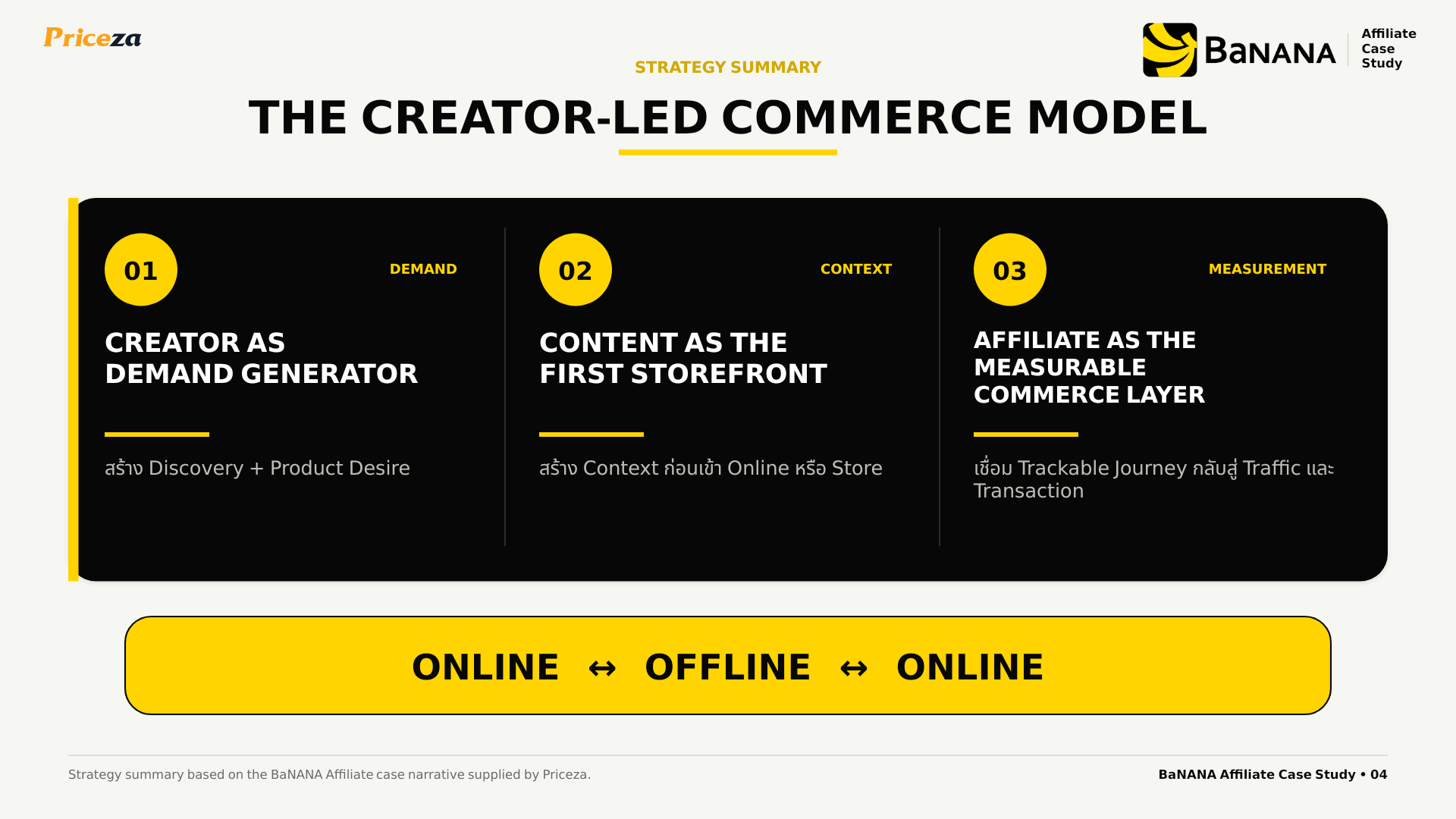
Looking at the big picture, the BaNANA affiliate case reflects three core strategies.
First is Creator as Demand Generator—instead of using creators solely to increase reach, content is placed where people are actively seeking inspiration, information, or validation. Creators thus help generate new demand and move consumers who already have intent closer to making a decision.
Second is Content as the First Storefront—because reviews or recommendations serve as a form of product experience before consumers choose to move on to a product page, store visit, or click & collect, depending on their preference.
And third is Affiliate as the Measurable Commerce Layer—which connects creator content to a trackable product journey, providing retailers with data to understand which partners, content formats, or product categories are effectively driving traffic and transactions.
These three components work together as:
Creator creates demand → Content builds intent → Affiliate captures measurable performance → Omnichannel Retail closes the journey
And the final destination for a purchase does not always have to be the same channel where the journey began.
What BaNANA Affiliate is signaling to the tech retail industry:
The key takeaway from this case isn't just whether affiliates can generate sales, but that commerce is becoming decentralized across the touchpoints consumers use to discover, learn, and decide.
Consumers might begin their journey on YouTube, Facebook, TikTok, gaming communities, or content publishers long before they ever see a retailer’s homepage. At the same time, physical stores and e-commerce still play a vital role in helping consumers test, compare, pick up products, and finalize transactions.
For tech retailers, the competitive advantage may no longer come from simply having the best store or e-commerce site, but from considering where the brand appears while demand is being formed.
BaNANA has a compelling foundation, supported by both a creator/affiliate layer and an omnichannel retail footprint. With a physical network of over 600 branches, BNN.in.th, and click & collect, consumers don't have to choose between online or offline from the start; they can utilize each channel based on what suits their needs at that moment.
Therefore, the new question for tech retail may not just be:
“How can we drive more people into our stores?”
But rather:
“How can we place our products where demand is forming and connect that demand back to measurable commerce?”
This is why creator content can serve as the “new storefront” for tech retail—not as a replacement for physical stores or e-commerce, but as a different type of storefront that helps build demand, provide product context, and create pathways into a larger commerce ecosystem.
From creator content to measurable commerce
The picture BaNANA Affiliate reflects is much larger than just placing affiliate links under content, as the core of the model is connecting the various assets tech retailers already possess to work in synergy.
Creators help generate demand and product context.
Content helps guide consumers from discovery to consideration.
Affiliates connect the trackable journey to traffic and transactions,
while omnichannel retail allows consumers to close their journey via online, physical stores, or click & collect, according to their own preferences.
This means creators no longer need to be viewed solely as media partners, and affiliates don't have to be seen just as tracking links. Instead, both can work together as part of a Creator-powered Commerce Infrastructure
For retailers already equipped with a product catalog, e-commerce platform, physical store network, and creator ecosystem, the opportunity lies not just in finding more creators, but in ensuring that the right product meets the right creator in the right context, supported by a measurable commerce path whenever demand arises.
Therefore, the key question may not be just
“How can we do creator marketing to get more visibility?”
But rather
“How can we connect the demand created by creators to commerce that brands can measure and manage?”
Creator sparks the demand.
Affiliate makes it measurable.
Commerce can happen anywhere.
Looking to scale creator content into your brand's affiliate program?
Priceza Affiliate Marketing helps brands build and manage an affiliate ecosystem that integrates partners, content, and performance.
For businesses looking to build a brand-owned affiliate program, you can use the Priceza Affiliate Partnership Management Platform (Shopfluence), an affiliate marketing software for affiliate registration, tracking, transaction attribution, performance reporting, and commission management.
Talk to Priceza about your Affiliate Program
FAQ
What is the BaNANA Affiliate program?
BaNANA Affiliate is a program that allows participants to select BaNANA products, create affiliate links, and share them via social media such as Facebook, Instagram, TikTok, or YouTube to earn commissions on qualifying orders.
How many products are available in the BaNANA Affiliate program, and what are the commission rates?
Current data indicates that BaNANA Affiliate offers over 10,000 products with commission rates of 3%–5%, depending on program terms.
How does creator affiliate differ from creator marketing?
Creator marketing can have objectives ranging from awareness and product education to engagement, whereas creator affiliate adds affiliate links and tracking mechanisms, allowing recommendations to be connected to clicks, transactions, and measurable performance.
These two approaches do not replace each other but can work together within the same commerce journey, with creators building demand and context while affiliates provide the ability to connect and measure performance in trackable parts of the journey.