
Affiliate Marketing 2026: 5 Players Reshaping the Ecosystem
Modern affiliate marketing goes beyond just brands and creators; it now connects five key players, spanning content, traffic, and trust, all the way to conversion, attribution, and revenue.


Integrate your CRM with other tools
Lorem ipsum dolor sit amet, consectetur adipiscing elit lobortis arcu enim urna adipiscing praesent velit viverra sit semper lorem eu cursus vel hendrerit elementum morbi curabitur etiam nibh justo, lorem aliquet donec sed sit mi dignissim at ante massa mattis.
- Neque sodales ut etiam sit amet nisl purus non tellus orci ac auctor
- Adipiscing elit ut aliquam purus sit amet viverra suspendisse potenti
- Mauris commodo quis imperdiet massa tincidunt nunc pulvinar
- Adipiscing elit ut aliquam purus sit amet viverra suspendisse potenti
How to connect your integrations to your CRM platform?
Vitae congue eu consequat ac felis placerat vestibulum lectus mauris ultrices cursus sit amet dictum sit amet justo donec enim diam porttitor lacus luctus accumsan tortor posuere praesent tristique magna sit amet purus gravida quis blandit turpis.

Techbit is the next-gen CRM platform designed for modern sales teams
At risus viverra adipiscing at in tellus integer feugiat nisl pretium fusce id velit ut tortor sagittis orci a scelerisque purus semper eget at lectus urna duis convallis. porta nibh venenatis cras sed felis eget neque laoreet suspendisse interdum consectetur libero id faucibus nisl donec pretium vulputate sapien nec sagittis aliquam nunc lobortis mattis aliquam faucibus purus in.
- Neque sodales ut etiam sit amet nisl purus non tellus orci ac auctor
- Adipiscing elit ut aliquam purus sit amet viverra suspendisse potenti venenatis
- Mauris commodo quis imperdiet massa at in tincidunt nunc pulvinar
- Adipiscing elit ut aliquam purus sit amet viverra suspendisse potenti consectetur
Why using the right CRM can make your team close more sales?
Nisi quis eleifend quam adipiscing vitae aliquet bibendum enim facilisis gravida neque. Velit euismod in pellentesque massa placerat volutpat lacus laoreet non curabitur gravida odio aenean sed adipiscing diam donec adipiscing tristique risus. amet est placerat.
“Nisi quis eleifend quam adipiscing vitae aliquet bibendum enim facilisis gravida neque velit euismod in pellentesque massa placerat.”
What other features would you like to see in our product?
Eget lorem dolor sed viverra ipsum nunc aliquet bibendum felis donec et odio pellentesque diam volutpat commodo sed egestas aliquam sem fringilla ut morbi tincidunt augue interdum velit euismod eu tincidunt tortor aliquam nulla facilisi aenean sed adipiscing diam donec adipiscing ut lectus arcu bibendum at varius vel pharetra nibh venenatis cras sed felis eget.
Affiliate marketing is no longer just about brands and creators: 5 players transforming affiliate marketing into a full-fledged ecosystem
When people think of affiliate marketing, they often picture a simple structure: a brand has a product, a creator promotes it, a consumer clicks the link, and the creator earns a commission once a sale is made.
But affiliate marketing today is far more complex.
Creators do more than just recommend products, platforms are no longer just spaces for posting content, and consumers no longer follow a linear path from "seeing a post" to "clicking a link" to "buying."
A consumer might see a product in a short video on TikTok, watch a detailed review on YouTube, search for the product name, read comments in a community, and only then return to a marketplace to purchase it days later.
Along the way, algorithms, content, traffic, affiliate links, product recommendations, attribution, and data all work in tandem.
This is why affiliate marketing is shifting from a simple brand-creator relationship to an ecosystem where multiple parties are connected throughout the entire customer journey.
Based on the Cube framework, the current affiliate and influencer marketing ecosystem can be viewed through five key groups: brands, platforms, platform-native creators, off-platform creators, and consumers.
And what’s interesting isn't just who is in the ecosystem, but how each party exchanges content, traffic, data, trust, and revenue with one another.
Content commerce isn't just a trend; it is becoming the very foundation of e-commerce.
The growing role of affiliate and creator marketing is partly driven by the rise of content commerce.
Momentum Works reports that in 2025, the total platform e-commerce GMV in Southeast Asia will reach approximately $157.6 billion, with content commerce accounting for $49.7 billion, or about 32% of the region's total platform e-commerce GMV, up from 20% the previous year.
This means that nearly one-third of all platform transaction value in the region is driven by experiences that integrate content with commerce.
Content no longer serves only to build awareness; it can now guide consumers from "product discovery" to "purchase decision" within a single journey.
Data from Cube also indicates that more than 80% of surveyed Southeast Asian consumers have purchased products via affiliate links, while trust and authentic product recommendations—not just discounts—are key factors in their decision-making.
This is where the worlds of influencer marketing and affiliate marketing begin to merge.
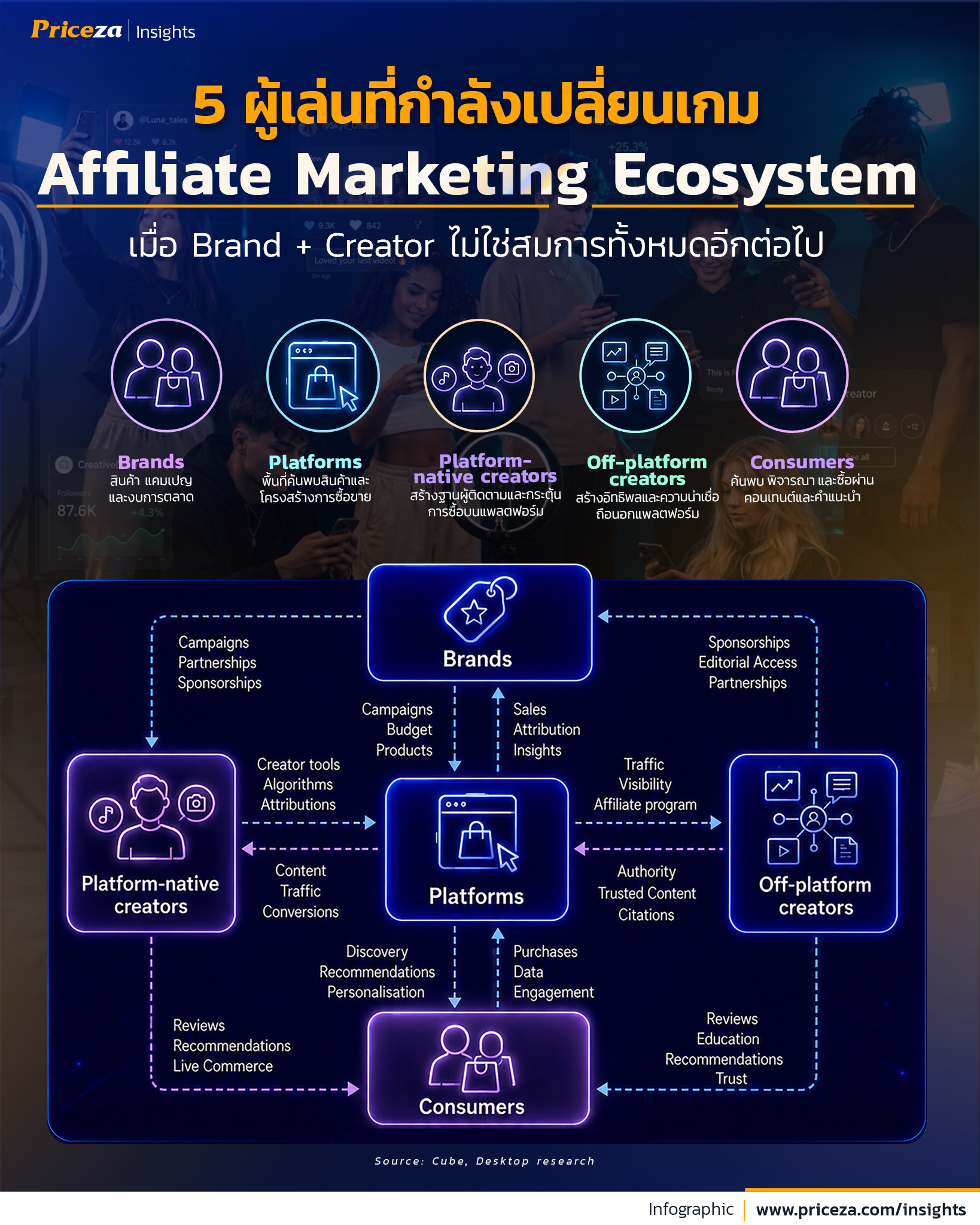
From brand and creator to a 5-party ecosystem
1. Brands: From product owners to managers of creator networks
Brands remain the source of products, campaigns, and marketing investment, but their role in the modern affiliate ecosystem goes far beyond simply choosing influencers and sending them a brief.
Brands must manage creators who play different roles throughout the customer journey.
Some creators excel at building awareness, others possess high authority and help build trust, while another group may not have a large audience but can effectively demonstrate products, host live streams, and drive conversions.
The question for brands has therefore shifted from
“Which influencer should we hire?”
to:
“What type of creator should handle which role, and what KPIs should be used to measure their performance?”
This has caused creator marketing to start resembling portfolio management rather than buying media on a campaign-by-campaign basis.
This trend is also clearly visible in the U.S. market. The IAB estimates that creator advertising spend will reach $37 billion in 2025, a 26% year-over-year increase, and is projected to grow to $44 billion in 2026, with 48% of ad buyers now viewing creators as a “must-buy” channel.
Creators are thus transitioning from a tactical marketing tool to a vital channel in media and commerce strategy.
2. Platforms: From content spaces to commerce infrastructure
If the brand is the product owner, the platform is the infrastructure controller that connects all players together.
Platforms hold power at many stages of the journey, from determining which content receives visibility via algorithms to providing creator tools, affiliate programs, product tags, advertising, attribution, and checkout.
What platforms provide to creators is not just an audience.
It also includes discovery, traffic, tools, and the ability to measure conversions.
At the same time, what creators give back to the platform is content, engagement, traffic, and transactions.
This creates a feedback loop where the more content there is, the more data the platform has, and the more data there is, the more precisely the recommendation system can match consumers, creators, and products.
The example of TikTok Shop Singapore reflects this direction well, with the number of affiliate creators more than doubling year-over-year, while e-commerce short videos increased 6.3 times, live hours from affiliate creators increased 1.7 times, and total affiliate GMV doubled during the reporting period. However, these figures are specific to the Singapore market and do not represent the entire region.
What is happening is not just social media + shopping.
But rather, platforms are becoming commerce infrastructure that connects content with transactions.
3. Platform-native creators: Creators born for discovery and conversion
One of the most interesting points of this framework is the separation of creators into two groups.
The first group is Platform-native Creators
In the context of this framework, this refers to creators who primarily build their audience and drive transactions within a platform's ecosystem, such as TikTok Shop Affiliate Creators, live hosts, Shopee Affiliate Creators, or Key Opinion Sellers (KOS).
This group of creators understands platform mechanics in great detail.
They know which hooks stop the scroll, what kind of content the algorithm is likely to amplify, how to demonstrate products to reduce customer hesitation, and which promotions effectively drive conversions.
Success, therefore, does not depend solely on follower count.
Some creators may have small to medium-sized audiences but can generate high product discovery and conversion rates because their content is directly tied to purchase intent.
The role of the creator has thus shifted from
Media Partner
to:
Commerce Partner
This is one of the reasons why affiliate marketing is increasingly functioning like a distributed sales network.
4. Off-platform Creators: Authority and Trust outside the marketplace algorithm.
However, not every creator needs to grow within a marketplace or social commerce platform.
Another group is Off-platform Creators, which may include YouTube reviewers, bloggers, publishers, media outlets, expert creators, communities, review sites, or independent affiliates.
The strengths of this group are different.
phase,Discovery → Conversion
phase.Research → Evaluation → Trust
Consider a consumer looking to buy a 30,000-baht appliance.
They might first see the product in a short video, but before deciding to buy, they may watch a 20-minute review on YouTube, search for comparisons between two models, read articles or comments from actual users, and only then return to the marketplace to make the purchase.
If measured solely by last-click conversion, the creator who produced the review might not receive credit for the sale.
But in reality, that content may have been the very thing that gave the consumer the confidence to make the purchase.
This requires brands to distinguish between
Creators who drive transactions
and
Creators who influence transactions
Both have value, but they shouldn't be measured by the same metrics.
5. Consumers: They are not just buyers, but contributors of data back into the ecosystem.
Consumers are at the heart of the affiliate ecosystem, but their role doesn't end with a purchase.
Every consumer interaction—whether it's a view, watch time, like, comment, search, click, add to cart, purchase, or review—sends signals back into the system.
Platforms use this data to refine algorithms and personalization.
Creators use this data to learn what type of content resonates with their audience.
Brands use this data to analyze campaigns, products, and creator performance.
This creates a continuous cycle:
Content → Attention → Data → Recommendation → Conversion → More Data
This is why viewing affiliate marketing as a linear funnel is no longer sufficient.
What actually happens is more like a flywheel or an ecosystem, where consumers can enter and exit the journey at various points, and a single interaction can influence future recommendations.
Platform-native creators and off-platform creators require different strategies.
Distinguishing between these two groups is crucial for affiliate strategy, as they each provide value at different stages of the customer journey.
Platform-native creators have the advantage of speed in driving discovery, fully utilizing native platform tools, and seamlessly linking content to affiliate links or checkout. They are ideal for short-form video, live commerce, product demonstrations, and conversion-driven content.
Meanwhile, off-platform creators have the advantage of authority and content depth. They help consumers conduct research, explain complex products, and build trust before a purchase, with traffic often coming from search, communities, or audiences they have built themselves.
Therefore, brands shouldn't just ask which creator has the highest affiliate sales.
But the real question is:
Where does this creator fit into the customer journey, and what kind of value are they creating for the brand?
3 Key Shifts in Affiliate Marketing
Looking at all five stakeholders together, we can see at least three structural changes.
Shift 1: From Influencer to Commerce Partner
Traditional influencer marketing usually focuses on awareness, reach, and engagement.
Affiliate infrastructure allows creators to link marketing results directly to sales more effectively.
The question has shifted from:
“How many views did this post get?”
to:
“How much discovery, traffic, new customers, and revenue did this content generate?”
However, this doesn’t mean every creator must be judged solely by sales figures.
Creators at the top of the funnel may focus on generating demand, while those at the bottom focus on converting that demand into transactions.
The challenge is to measure contribution in alignment with their specific role.
Shift 2: From Campaign-based to an Always-on Creator Network
In traditional influencer marketing, creators were often selected for mega-campaigns like 9.9, 10.10, or 11.11, with the relationship ending once the campaign concluded.
But affiliate commerce requires a network that operates continuously.
Creators must be recruited, onboarded, provided with products, tested for content performance, analyzed, and nurtured throughout the year.
High-performing creators may receive higher commissions, early access to product launches, or additional paid amplification.
Meanwhile, new creators can join the network at any time.
Affiliate programs are starting to function more like an always-on growth engine rather than a campaign with a fixed start and end date.
Shift 3: From Reach to Revenue + Attribution
With creators using affiliate links and platform attribution, brands can now track conversions with far greater precision than in the days when they relied solely on reach and engagement.
However, this granular measurement brings new questions to the table.
If a customer has already seen a brand's ad but clicks an affiliate link right before checkout, should the creator receive full credit for that sale?
Conversely, if a creator’s review introduces someone to a product, but the consumer searches for the brand and buys it themselves three days later, did that creator generate the sale?
This is why affiliate measurement must shift from:
“Who gets credit for the order?”
to:
“Who is actually driving incremental value for the business?”
Brands should therefore expand their focus beyond just sales and ROAS to include new customers, assisted conversions, customer acquisition costs, contribution margins, and incremental revenue.
So, how should brands adjust their affiliate strategy?
First, stop categorizing creators solely by follower count and start organizing them by their role in the customer journey.
Some creators should focus on discovery, others on building authority and trust, while commerce creators or KOS can be utilized for product demonstrations, live sessions, and driving conversions.
Once the roles are defined, the KPIs will naturally become clearer.
Second, avoid measuring every creator by last-click sales, as this may lead brands to stop investing in content that influences demand at the top of the funnel, even if that content doesn't directly close the order.
Third, brands should start integrating influencer marketing data with affiliate data.
A single creator can drive both awareness and sales.
Therefore, affiliate data can help answer investment questions, such as which creators deserve higher fixed fees, who should receive higher commissions, which content should be boosted with paid media, and which creators should be developed into long-term brand partners.
When influencer and affiliate budgets are viewed together, brands gain a much clearer picture of the customer journey than by managing the two channels separately.
Affiliate marketing isn't replacing influencer marketing; it is bridging the gap between influence and commerce.
The growth of affiliate marketing does not mean brands should turn every creator into a salesperson.
Because every creator plays a different role.
Some help consumers discover products.
Some build brand credibility.
Some help explain complex products.
Some are highly effective at closing sales.
And a single creator may fulfill multiple roles simultaneously.
The key shift, therefore, is not about choosing between influencer marketing or affiliate marketing.
It is about understanding that influence and commerce are converging.
And as brands, platforms, creators, and consumers become connected through content, algorithms, data, and attribution, managing creators on a campaign-by-campaign basis is no longer enough.
Priceza Insights View
Affiliate marketing is evolving from a "channel" into an "ecosystem."
In an era where content can drive transactions, and transactions can generate data to instantly optimize content, brands, platforms, and creators can no longer be managed in silos as they were in the past.
A brand's competitive advantage may no longer lie in who can hire the most famous influencer or who has the largest number of affiliates.
But rather in
how well a brand can design a creator ecosystem that integrates discovery, trust, conversion, and measurement.
From influencer to commerce partner.
From campaign to always-on creator network.
And from reach to revenue and incremental value.
This is why the next generation of affiliate marketing is no longer just about brands and creators.
It is becoming an ecosystem where all five stakeholders must grow and create value together.
FAQ: Affiliate Marketing and Creator Commerce
What is Affiliate Marketing?
Affiliate Marketing is a marketing model where a brand or merchant compensates a partner for specific outcomes, such as clicks, leads, or sales. Today, creators can engage in affiliate marketing through content, short videos, live streams, or recommendations, earning commissions on resulting conversions.
How does Affiliate Marketing differ from Influencer Marketing?
Influencer Marketing typically leverages creators to build awareness, reach, engagement, and trust, often compensated via fixed fees. In contrast, Affiliate Marketing is performance-driven, with compensation tied directly to results like sales. However, today’s creators often fulfill both roles simultaneously.
What is Creator Commerce?
Creator Commerce is a trading system where creators and their content play a direct role from product discovery and recommendation through to conversion. Platforms integrate creator tools, algorithms, affiliate programs, attribution, and commerce infrastructure to facilitate this.
What is a Platform-native Creator?
In this framework, it refers to creators who primarily build their audience and drive conversions within a platform ecosystem, utilizing native tools like short videos, live streams, product tags, and affiliate programs to generate transactions.
Should brands measure affiliate creators solely by sales?
No, because each creator plays a different role in the customer journey. Some excel at discovery or building trust without being the final click, while others specialize in conversion. Brands should measure performance based on the specific role each creator plays.
Data Source Note: The 5-player framework in this article is adapted from Cube’s Affiliate and Influencer Marketing Ecosystem, supplemented by market data from Momentum Works, Cube, IAB, and TikTok Shop. Data from the U.S. and Singapore illustrates industry trends and should not be interpreted as direct statistics for the Thai market.


