
How is AI Shopping transforming search? Lessons from 31 million users
Research on 31 million Ctrip users reveals that AI shopping and search are used in tandem, along with 6 ways to prepare product data so your brand gets discovered in the AI era.


Integrate your CRM with other tools
Lorem ipsum dolor sit amet, consectetur adipiscing elit lobortis arcu enim urna adipiscing praesent velit viverra sit semper lorem eu cursus vel hendrerit elementum morbi curabitur etiam nibh justo, lorem aliquet donec sed sit mi dignissim at ante massa mattis.
- Neque sodales ut etiam sit amet nisl purus non tellus orci ac auctor
- Adipiscing elit ut aliquam purus sit amet viverra suspendisse potenti
- Mauris commodo quis imperdiet massa tincidunt nunc pulvinar
- Adipiscing elit ut aliquam purus sit amet viverra suspendisse potenti
How to connect your integrations to your CRM platform?
Vitae congue eu consequat ac felis placerat vestibulum lectus mauris ultrices cursus sit amet dictum sit amet justo donec enim diam porttitor lacus luctus accumsan tortor posuere praesent tristique magna sit amet purus gravida quis blandit turpis.

Techbit is the next-gen CRM platform designed for modern sales teams
At risus viverra adipiscing at in tellus integer feugiat nisl pretium fusce id velit ut tortor sagittis orci a scelerisque purus semper eget at lectus urna duis convallis. porta nibh venenatis cras sed felis eget neque laoreet suspendisse interdum consectetur libero id faucibus nisl donec pretium vulputate sapien nec sagittis aliquam nunc lobortis mattis aliquam faucibus purus in.
- Neque sodales ut etiam sit amet nisl purus non tellus orci ac auctor
- Adipiscing elit ut aliquam purus sit amet viverra suspendisse potenti venenatis
- Mauris commodo quis imperdiet massa at in tincidunt nunc pulvinar
- Adipiscing elit ut aliquam purus sit amet viverra suspendisse potenti consectetur
Why using the right CRM can make your team close more sales?
Nisi quis eleifend quam adipiscing vitae aliquet bibendum enim facilisis gravida neque. Velit euismod in pellentesque massa placerat volutpat lacus laoreet non curabitur gravida odio aenean sed adipiscing diam donec adipiscing tristique risus. amet est placerat.
“Nisi quis eleifend quam adipiscing vitae aliquet bibendum enim facilisis gravida neque velit euismod in pellentesque massa placerat.”
What other features would you like to see in our product?
Eget lorem dolor sed viverra ipsum nunc aliquet bibendum felis donec et odio pellentesque diam volutpat commodo sed egestas aliquam sem fringilla ut morbi tincidunt augue interdum velit euismod eu tincidunt tortor aliquam nulla facilisi aenean sed adipiscing diam donec adipiscing ut lectus arcu bibendum at varius vel pharetra nibh venenatis cras sed felis eget.
AI shopping isn't replacing search: From keywords to conversation, how brands should prepare their product data
Are consumers really abandoning search in favor of asking AI?
Recent evidence suggests that the shift isn't a straightforward case of "new channels replacing old ones." Instead, consumers are using AI shopping and search together at different stages of the customer journey.
When unsure what to search for, consumers may describe their problem, budget, or specific requirements to help AI organize their thoughts. They then return to search for brand names, check prices, read reviews, and compare options before making a purchase.
Therefore, AI isn't making search disappear; it is shifting the starting point of product discovery from typing short keywords to engaging in more contextual conversations.
For brands, the critical question is no longer just:
"Does our website rank in search results?"
But must now include:
"Is our product data clear and comprehensive enough for AI to understand, compare, and recommend?"
What did the study of 31 million users examine?
The research paper, Shopping with a Platform AI Assistant: Who Adopts, When in the Journey, and What For, analyzes the usage of "Wendao," an AI assistant embedded within Ctrip, one of China's largest online travel platforms.
The sample consisted of 31,142,353 users who logged in between July 10–24, 2025. Researchers tracked activity over a broader period from June 10 to August 15, 2025, to observe the connections between AI chat, keyword search, clicks, and purchases within the same platform.
Out of the total sample, approximately 1.9 million users, or 6.1%, had initiated a conversation with the AI assistant prior to the study's reference date, and 188,647 users could be linked to conversations occurring during the observed data period.
Published in March 2026 as a preprint, the study has not yet undergone full academic peer review. However, it serves as significant behavioral evidence illustrating where AI assistants fit into the search and purchase decision-making process.
3 key findings from 31 million Ctrip users
Finding 1: AI shopping users aren't just the younger generation
The common perception is that early adopters of AI are typically younger people or those who are tech-savvy.
However, within the AI shopping system embedded in Ctrip, researchers found that usage rates actually increase with age.
- ผู้ใช้อายุ 50 ปีขึ้นไปมีอัตราการใช้ AI Assistant 10.7%
- ผู้ใช้อายุต่ำกว่า 24 ปีมีอัตราการใช้ 4.6%
- ผู้หญิงมีอัตราการใช้ 7.1% เทียบกับผู้ชาย 6.0%
Furthermore, the best predictors of usage are not age or gender, but rather the user's existing level of engagement with the platform, such as session duration, session count, and login frequency.
Key takeaways for brands
AI shopping tools are not exclusively for Gen Z or early adopters.
Consumers who use a platform regularly and face an overwhelming number of choices may see the benefits of AI more clearly, as it reduces the burden of translating complex needs into multiple keyword searches.
For example:
“I’m looking for a hotel for my parents that doesn’t require much walking, is near restaurants, and is easy to reach from the airport.”
This type of query is better handled through conversation than by searching for individual terms like “hotel near airport,” “senior-friendly hotel,” or “hotel near restaurants.”
However, these findings regarding age and gender reflect behavior on Chinese travel platforms and should not be generalized to assume that older consumers will use AI shopping more than younger generations across all markets and platforms.
Finding 2: AI chat and search are used together more than you might think.
Research shows that AI chat is often used in conjunction with traditional product searches, typically occurring before a purchase is made.
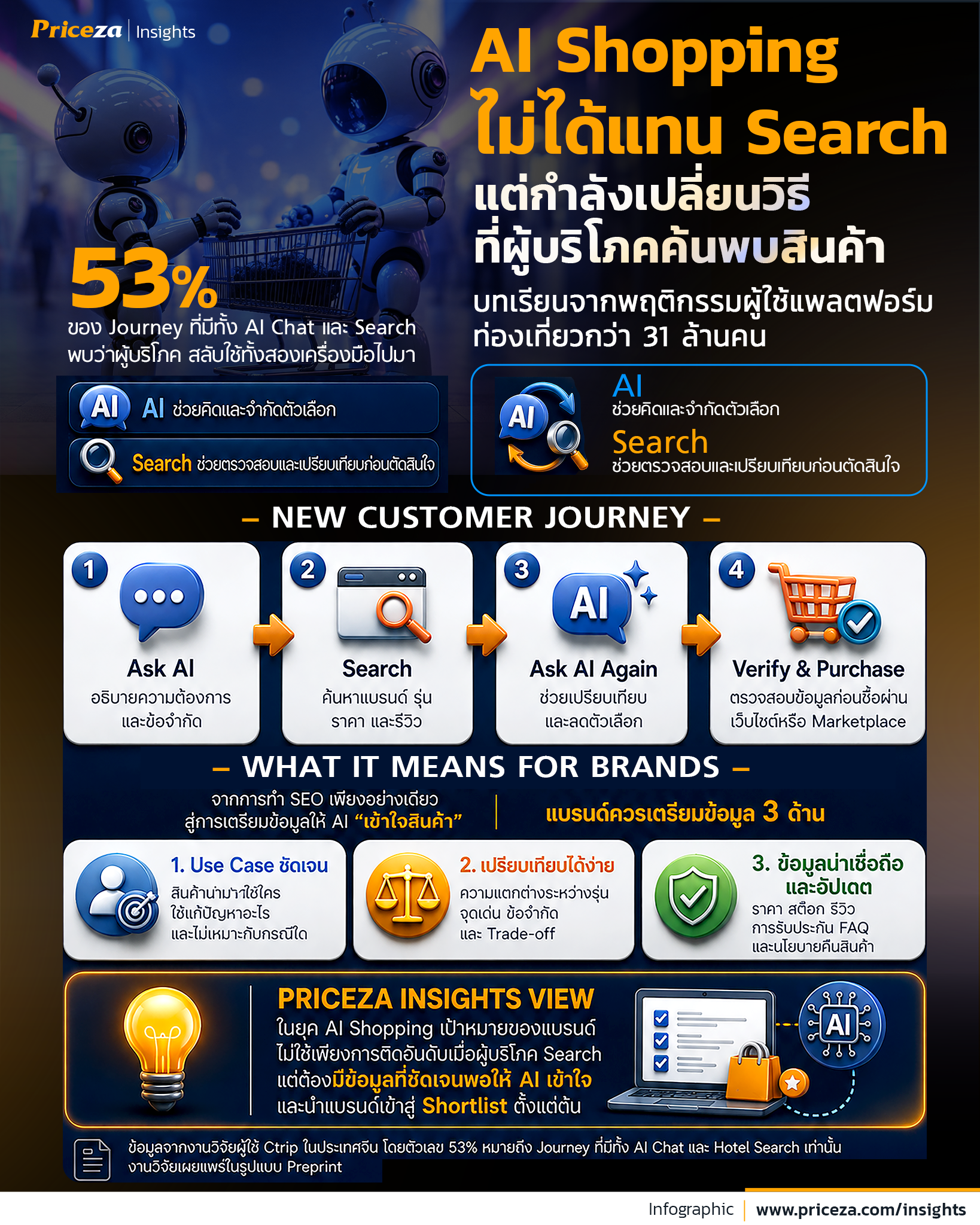
When looking specifically at journeys that include both AI chat and hotel search, the most common pattern is interleaving, or switching back and forth between the two tools, accounting for 53% of these journeys.
Another 26% involve asking the AI before searching, while 21% involve searching first and then returning to the AI for further assistance.
A customer journey might look like this:
Ask AI → Search options → Return to AI → View details → Make a decision
Or:
Search first → Find too many options → Ask AI to compare → Return to product page
However, looking at all journeys involving AI chat, research shows that 42% are chat-only journeys that do not include a hotel search, indicating that AI can serve as a standalone discovery channel in certain situations.
Search helps consumers “find.”
Search is ideal when consumers already know what they want, such as a specific brand name, model, location, or set of features.
AI helps consumers “think.”
AI is best suited for ambiguous queries, tasks that require connecting multiple conditions, or when users need help narrowing down options and weighing trade-offs.
For brands, this means that AI Search Optimization should not replace SEO, but rather complement it, ensuring your brand appears both when AI generates a shortlist and when consumers return to verify information via search.
Finding 3: AI excels at queries that are difficult to describe with keywords.
Questions about tourist attractions account for 42% of all AI chat requests, the highest in this study, followed by hotel-related questions at 18% and travel planning at 7%.
This difference reflects the nature of each type of query.
Hotel searches can begin with relatively structured data, such as dates, city, budget, or star rating.
However, planning tourist activities may require considering multiple conditions simultaneously, such as:
- Is it suitable for children or the elderly?
- How much walking is involved?
- What is the best time to visit?
- Is it near the hotel or train station?
- Can it be combined with other locations on the same day?
These types of queries are hard to convert into short keywords, but they are much easier to express in natural language for AI to interpret.
From travel to other product categories
Although the Ctrip study did not directly examine retail products, the results can be used to form strategic hypotheses for products with complex options and conditions, such as:
Beauty and Skincare
“I have sensitive, acne-prone skin and need a moisturizer that isn't heavy and can be used with retinol.”
Home Appliances
“I need an air purifier for a 35-square-meter condo, I have a cat, and I want a model that is quiet at night.”
Baby and Maternity Products
“Which stroller model is suitable for a newborn, fits into a small car when folded, and is convenient for international travel?”
B2B Products
“Which system supports multiple branches, integrates with our existing ERP, and has a support team based in Thailand?”
Product categories that require explaining use cases, constraints, and trade-offs are more likely to benefit from Conversational Product Discovery than products decided solely by model name or price.
This is a strategic application of the research findings, not a conclusion directly proven by the Ctrip study for these specific product categories.
AI helps drive discovery, but consumers still turn to Search
Another study published in June 2026 examined behavior on the Open Web after users received brand recommendations from ChatGPT, Claude, and Gemini.
When AI recommended a brand that the user had not previously engaged with, the likelihood of the user searching for that brand name on Google increased by 4.3 percentage points. Brand website visits rose by 2.4 percentage points, and visits to brand pages on retailer sites increased by 1 percentage point.
The path following a recommendation still largely runs through Search.
However, this was an observational study rather than a randomized experiment, and researchers did not have access to transaction data, so it cannot be definitively concluded that AI recommendations directly drive sales.
What the data does support is that AI can act as an Upstream Discovery Channel, bringing brands into the consideration set before consumers head to Search, brand websites, or retailers.
The new customer journey may therefore look like this:
Ask AI → Discover Brand → Search Brand → Compare → Visit Website or Marketplace → Purchase
The new challenge of attribution
If a consumer discovers a brand through AI but searches for the brand name on Google before purchasing, last-click attribution systems may credit Organic or Paid Search.
Even though AI was the touchpoint that built awareness and placed the brand on the shortlist from the very beginning.
Brands should therefore track additional signals, such as:
- Increases in Branded Search
- Direct traffic after the brand is mentioned on AI
- Landing pages frequently visited by users coming from AI
- Survey responses regarding "Where did you hear about us?"
- Assisted conversions occurring after multiple touchpoints
- The frequency and context in which the brand is recommended by AI
AI visibility is not static like Search rankings, as answers can change based on prompts, context, models, accessible data, and timing. Measurement should therefore utilize a set of queries that reflect actual customer intent and be monitored continuously.
Smarter AI does not always mean higher conversions.
Another study conducted on more than 510,000 travel platform users randomly assigned participants to access an AI assistant using either a reasoning model or a non-reasoning model.
The results showed that access to reasoning-based AI led to a 2.5% decrease in hotel bookings, with users performing fewer searches, viewing fewer options, and clicking on fewer hotels, despite having higher engagement with the AI.
These results do not mean that AI is inherently detrimental to e-commerce, but they do demonstrate that AI which summarizes answers or limits choices too quickly may reduce consumer exploration.
Therefore, the challenge for AI shopping experiences is not just about providing the fastest or most comprehensive answers, but about finding the right balance between:
- Simplifying complexity
- Encouraging exploration
- Explaining the reasoning behind recommendations
- Presenting options and trade-offs
- Guiding consumers to the next step effectively
From SEO to AI-ready product data
In the world of search, brands have traditionally prioritized keywords, rankings, backlinks, and content.
While these elements remain important, the era of AI shopping requires brands to add another layer: structuring data so systems can answer questions like:
- What is this product?
- Who is it for?
- What problem does it solve?
- How does it differ from other models?
- What are the limitations or trade-offs?
- What is the latest price and stock status?
- Are there reviews or evidence to support it?
- How do I return or claim a warranty?
OpenAI states that product feeds allow merchants to better control the completeness and accuracy of product information appearing in ChatGPT. Basic feeds must include data such as product ID, title, description, URL, image, availability, price, and brand.
As of this writing, shopping in ChatGPT is available in the United States, and direct product feed integration is being rolled out to merchants in other regions. Users can discover and evaluate products within ChatGPT, but purchases are completed on the merchant's website or app.
Google has also begun allowing merchants to submit conversational attributes in addition to standard product data to help AI systems better understand product details and differentiators. AI Performance Insights in Merchant Center is currently in a pilot program for select accounts in the U.S., with plans for further international expansion.
For Thai brands, these features may not be fully accessible to every business immediately, but it is a clear signal that product feeds are evolving from a tool for shopping ads into a vital database for AI product discovery.
6 things brands should prepare for the AI shopping era
1. Ensure basic data is accurate and consistent across all channels
Product names, brands, models, prices, stock levels, colors, sizes, images, URLs, and shipping terms should be consistent across websites, marketplaces, and product feeds.
If the price in the feed does not match the product page, or if different model names are used across channels, the system may link the data incorrectly or fail to determine which information is current.
The primary goal, therefore, is not just to write longer content, but to create a single source of truth for product information.
2. Explain use cases, not just features
A traditional product description might state:
“HEPA air purifier, 45 watts, covers an area of 40 square meters.”
Data optimized for conversational queries should add context, such as:
“Ideal for bedrooms or condos up to 40 square meters, homes with pets, and those looking to reduce PM2.5 dust. Features a quiet mode for nighttime use.”
AI must understand both what the product is and what situations it is suitable for.
3. Prepare comparison data and trade-offs
Consumers don't just ask "which model is the best," but may also ask:
- Which model offers the best value for this budget?
- Which model is best for beginners?
- Which model is lighter but has less battery life?
- What are the benefits of paying more for a higher-end model?
- Which model is not suitable for certain use cases?
Brands should provide information such as comparison tables, key highlights, limitations, target user profiles, and the rationale for choosing between different models.
Data that transparently explains trade-offs is more helpful for decision-making than claims that a product is "the best" in every aspect.
4. Enhance credibility-building information
Information that helps both consumers and AI evaluate credibility includes:
- Reviews and review counts
- Warranty
- Return policy
- Standards or certifications
- Test results
- Usage instructions
- Precautions
- Frequently asked questions
For claims regarding health, safety, or performance, there should be clear evidence and supporting sources.
5. Make key information machine-readable
Information should not be trapped solely within images, videos, clickable tabs, or elements rendered via JavaScript without corresponding text on the page.
Adobe reported that the product detail pages of US retail websites they audited had an average machine readability score of only 66%, meaning that some information visible to users may not be fully accessible to AI systems.
Brands should audit elements such as:
- Product Feed
- Structured Data
- Specification Table
- Text-based FAQs
- Alt Text
- Clear Headings
- Accessible URLs
- Updated pricing and availability
6. Measure both Search Visibility and AI Visibility
Brands must continue to track organic rankings, branded search, and search-driven conversions.
At the same time, you should start monitoring:
- Which questions lead AI to recommend your brand or products?
- Is your brand recommended during the discovery or evaluation phase?
- Is the information AI uses to answer accurate?
- Which competitors appear in the answers instead?
- Do answers differ across various AI platforms?
- How does AI visibility correlate with branded search and direct traffic?
Google has begun testing the categorization of AI shopping queries into three stages—discovery, evaluation, and purchase—within AI Performance Insights, reflecting that future visibility metrics may need to look beyond just rankings or clicks.
Is SEO still relevant in the era of AI shopping?
SEO is still important, but its role is evolving.
Search engines and AI assistants rely on websites, product feeds, reviews, and external data sources to understand products.
Effective SEO helps ensure:
- Your website is accessible and readable.
- Content structure is clear.
- Information addresses search intent.
- Your brand establishes authority.
- Product pages are indexed.
- Consumers can find your brand after receiving AI recommendations.
The shift is that brands should no longer create content just to target keywords; they must answer questions that arise throughout the entire product consideration process.
Moving from the original goal of:
Ranking when consumers search.
Expanding toward:
Being understood and considered when consumers ask AI.
The new customer journey in the era of AI shopping:
1. Explore
Consumers describe their problems, goals, budgets, and constraints to AI for assistance.
2. Refine
AI asks follow-up questions to narrow down requirements, such as size, usage patterns, or what the consumer prioritizes most.
3. Shortlist
AI summarizes product categories, models, or brands that might be a good fit, along with explanations of the differences.
4. Verify
Consumers return to search to read reviews, check prices, stock availability, retailers, and brand credibility.
5. Purchase
Consumers make a purchase through a brand website, marketplace, or retailer that offers the best terms and experience.
In this journey, AI doesn't have to be the final step of a purchase; it can act as an assistant that organizes needs and determines which brands make it onto the shortlist from the very beginning.
Priceza Insights View
The arrival of AI shopping does not mean that search is disappearing.
Instead, it is blurring the lines between search, recommendations, and conversation. more and more.
Consumers still use search to check prices, read reviews, compare stores, and access purchase channels. However, before reaching that stage, AI may play a role in interpreting their needs and defining the first options the consumer sees.
Competition, therefore, doesn't just happen on the search results page; it begins the moment AI starts trying to understand the consumer's query.
The winners in this era may not be the brands that write the longest product descriptions or stuff the most keywords.
But rather, the brands with product data that is accurate, structured, descriptive of use cases, easy to compare, and credible enough for consumers, search engines, and AI to understand in the same way.
From keywords to conversation, the new goal for brands is not just to be found, but to be understood well enough to be recommended.
Frequently Asked Questions About AI Shopping
What is AI Shopping?
AI Shopping is the use of AI to help explore, search, compare, and select products. Consumers can describe their needs in natural language, ask follow-up questions, and have AI consider multiple constraints simultaneously.
Will AI Shopping replace search?
Evidence from Ctrip shows that AI chat can function both as a standalone tool and in conjunction with search. When a journey involves both, the most common pattern is switching between them, suggesting that it is more likely to complement and evolve how we use search rather than replace it entirely.
How important is product data to AI shopping?
AI requires data—such as product names, prices, stock levels, features, use cases, and differentiators—to evaluate which products best fit a consumer's query. Incomplete or inconsistent data may cause products to be omitted or inaccurately described.
Do brands still need to do SEO?
Yes, because consumers may return to search after receiving AI recommendations, and AI itself relies on data from websites, product feeds, and web sources. SEO must therefore evolve from targeting keywords to creating data that addresses intent and is readable by various types of systems.
Which types of products are best suited for conversational shopping?
Products with many options, those requiring multiple criteria to be considered, or those with specific use cases—such as travel, beauty, electronics, baby products, and B2B goods—are likely to benefit because consumers can describe their problems and constraints through conversation. However, the actual impact should be tested separately across different product categories and customer segments.
Note: The Ctrip research is a preprint and studied users of a travel platform in China. Results should be used as directional insights and should not be cited as representative of consumer behavior in every country or product category. Product information and features for OpenAI and Google are based on the status verified as of August 5, 2026, and may change according to availability in each country.


