
Retail Thailand 2026: Why convenience stores are outperforming other retail formats
Inside Thailand's 2026 retail landscape: Modern trade growth is slowing, yet convenience stores remain a resilient format driven by essential spending, quick trips, and O2O retail.


Integrate your CRM with other tools
Lorem ipsum dolor sit amet, consectetur adipiscing elit lobortis arcu enim urna adipiscing praesent velit viverra sit semper lorem eu cursus vel hendrerit elementum morbi curabitur etiam nibh justo, lorem aliquet donec sed sit mi dignissim at ante massa mattis.
- Neque sodales ut etiam sit amet nisl purus non tellus orci ac auctor
- Adipiscing elit ut aliquam purus sit amet viverra suspendisse potenti
- Mauris commodo quis imperdiet massa tincidunt nunc pulvinar
- Adipiscing elit ut aliquam purus sit amet viverra suspendisse potenti
How to connect your integrations to your CRM platform?
Vitae congue eu consequat ac felis placerat vestibulum lectus mauris ultrices cursus sit amet dictum sit amet justo donec enim diam porttitor lacus luctus accumsan tortor posuere praesent tristique magna sit amet purus gravida quis blandit turpis.

Techbit is the next-gen CRM platform designed for modern sales teams
At risus viverra adipiscing at in tellus integer feugiat nisl pretium fusce id velit ut tortor sagittis orci a scelerisque purus semper eget at lectus urna duis convallis. porta nibh venenatis cras sed felis eget neque laoreet suspendisse interdum consectetur libero id faucibus nisl donec pretium vulputate sapien nec sagittis aliquam nunc lobortis mattis aliquam faucibus purus in.
- Neque sodales ut etiam sit amet nisl purus non tellus orci ac auctor
- Adipiscing elit ut aliquam purus sit amet viverra suspendisse potenti venenatis
- Mauris commodo quis imperdiet massa at in tincidunt nunc pulvinar
- Adipiscing elit ut aliquam purus sit amet viverra suspendisse potenti consectetur
Why using the right CRM can make your team close more sales?
Nisi quis eleifend quam adipiscing vitae aliquet bibendum enim facilisis gravida neque. Velit euismod in pellentesque massa placerat volutpat lacus laoreet non curabitur gravida odio aenean sed adipiscing diam donec adipiscing tristique risus. amet est placerat.
“Nisi quis eleifend quam adipiscing vitae aliquet bibendum enim facilisis gravida neque velit euismod in pellentesque massa placerat.”
What other features would you like to see in our product?
Eget lorem dolor sed viverra ipsum nunc aliquet bibendum felis donec et odio pellentesque diam volutpat commodo sed egestas aliquam sem fringilla ut morbi tincidunt augue interdum velit euismod eu tincidunt tortor aliquam nulla facilisi aenean sed adipiscing diam donec adipiscing ut lectus arcu bibendum at varius vel pharetra nibh venenatis cras sed felis eget.
Retail Thailand 2026: Why convenience stores are the most compelling retail format to watch
As purchasing power slows, consumers are prioritizing essentials, shopping closer to home, and embracing a "small basket, quick trip" lifestyle.
The 2026 retail landscape in Thailand presents an intriguing paradox. On one hand, consumer purchasing power remains fragile, confidence is waning, and people are becoming more cautious with their spending. On the other hand, certain retail formats are proving to be more resilient to these pressures than others.
And one of the most standout formats is the convenience store.
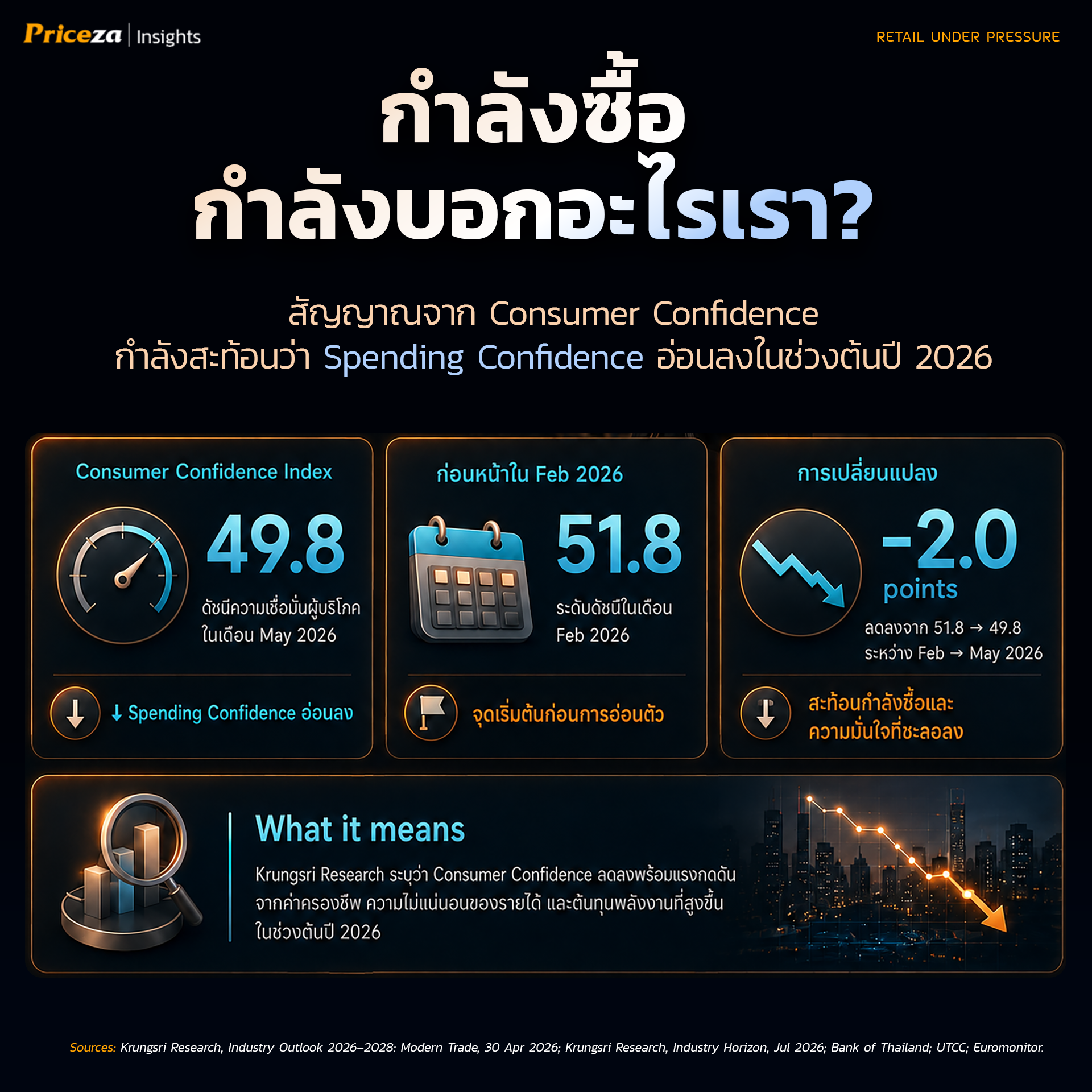
Krungsri Research noted in its Industry Horizon July 2026 report that during the first five months of the year, modern trade faced mounting pressure from the cost of living, energy costs, and weak purchasing power. The Consumer Confidence Index fell from 51.8 in February to 49.8 in May 2026, while the retail sales index for department stores and supermarkets contracted by 1.5% year-on-year between March and April.
However, the interesting takeaway is that while consumers are becoming more cautious with their money, they haven't stopped buying daily necessities—they are simply changing "how" they shop.
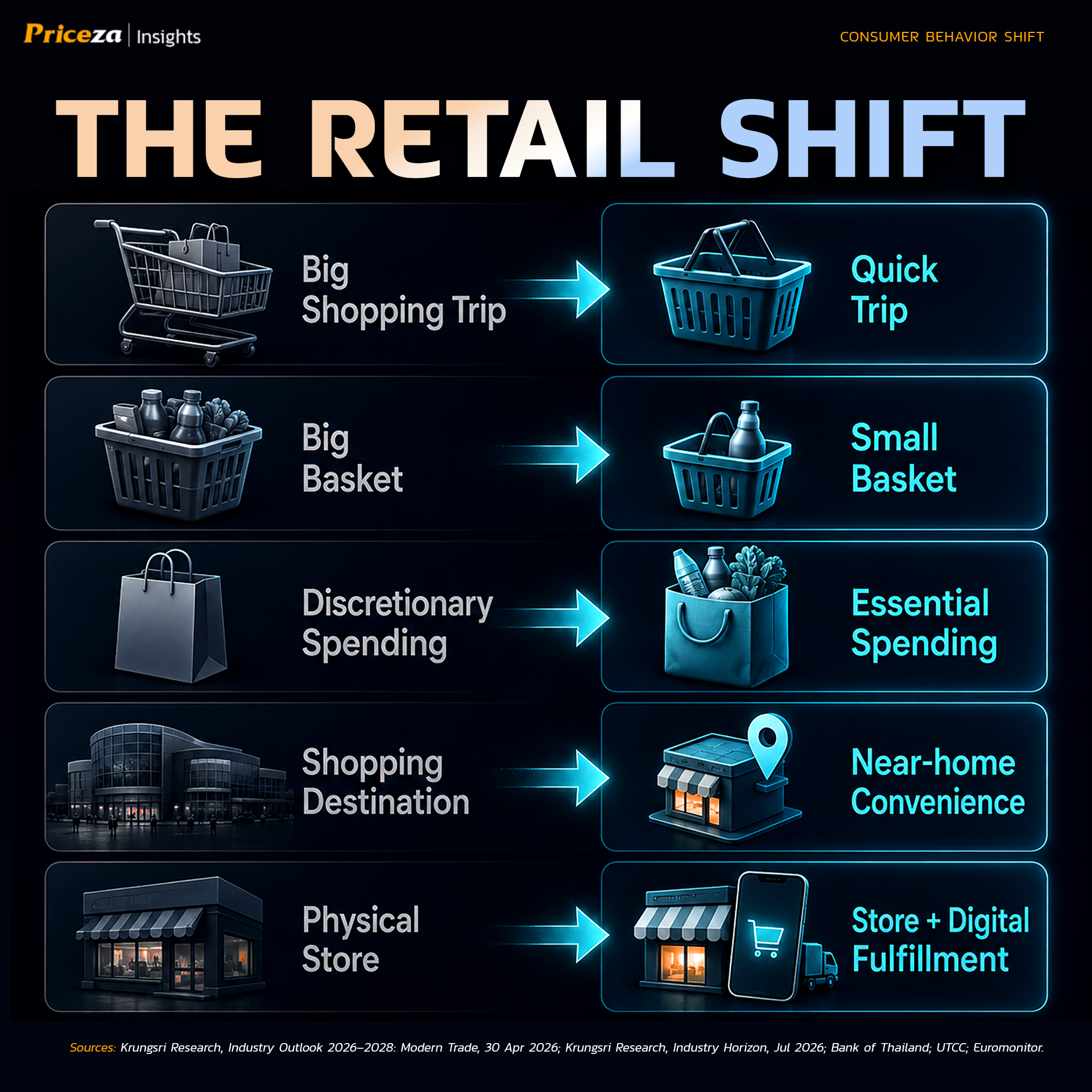
Large-scale shopping trips are shifting toward smaller, more frequent purchases; planned excursions to shopping destinations are being replaced by visits to neighborhood stores; and planned shopping trips are evolving into quick, local, and on-demand purchases. This is the context making convenience stores increasingly vital in Thailand's retail landscape.
Retail Thailand 2026 is growing more slowly, but not all formats are growing at the same rate.
Krungsri Research estimates that modern trade as a whole will grow by approximately 2.0–2.5% in 2026, a slowdown from the previous year, amid weak purchasing power and a lack of full recovery in discretionary spending. Convenience stores and supermarkets are seen as key market drivers because consumers still need to spend on daily essentials.
Looking at the 2026–2028 period, the divergence between retail formats will become even more pronounced. Krungsri Research projects the following average annual revenue growth for each format:
- Convenience Store / Minimart: +4.5–5.2%
- Supermarket: +3.0–4.0%
- Department Store: +2.0–3.0%
- Hypermarket / Supercenter: +1.2–2.2%
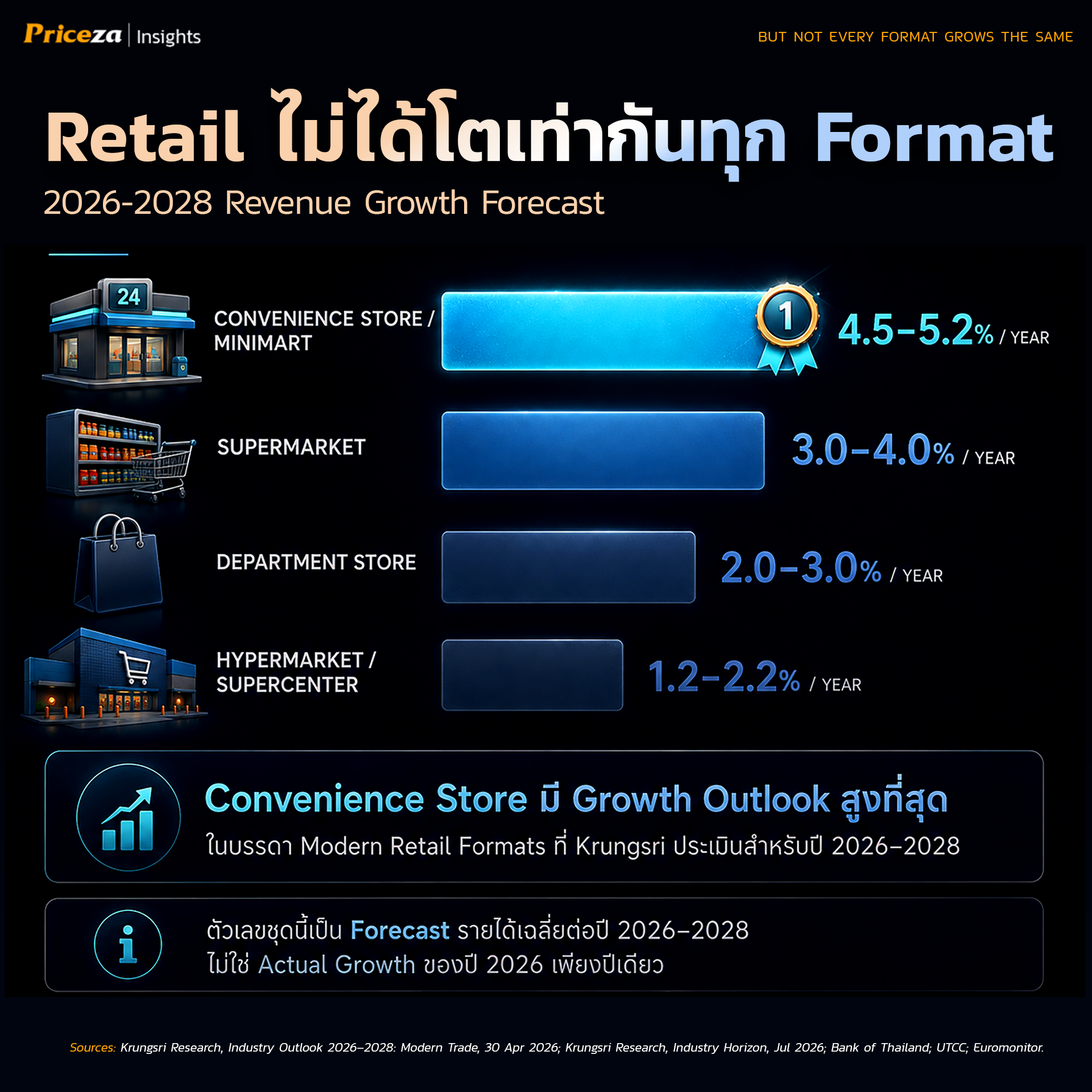
These figures do not mean that convenience stores will "win" over every other retail type, as each format serves different customer missions and bases. However, it does reflect that convenience stores have one of the strongest growth outlooks during a period of constrained purchasing power.
1. When every penny counts, "essentials" have the advantage
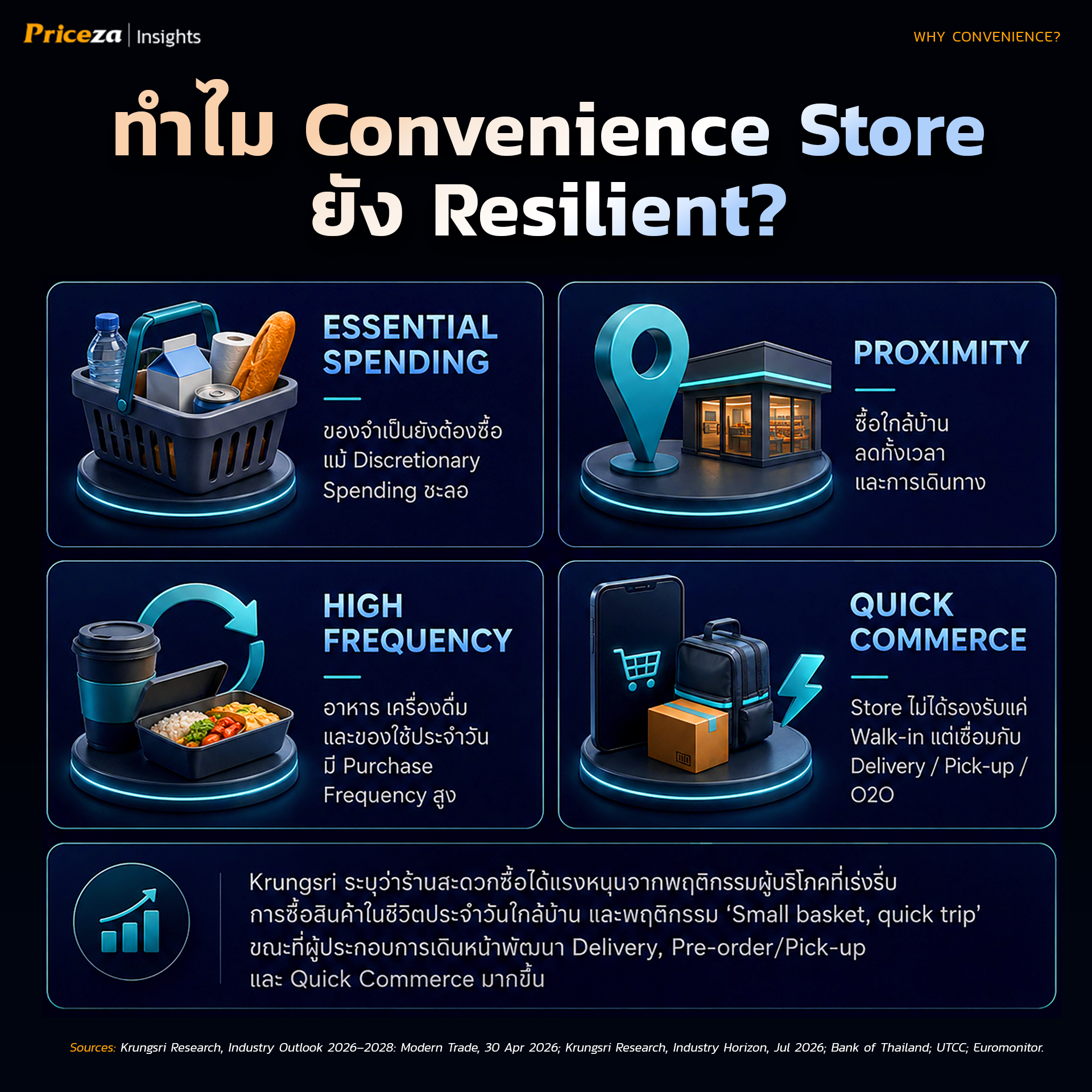
A key reason for the resilience of convenience stores is that their product mix is highly integrated into daily life. On days when consumers cut back on big-ticket items or defer non-essential purchases, the demand for food, beverages, daily necessities, and immediate-need items does not disappear.
Krungsri observes that low-to-middle-income consumers are increasingly prioritizing essential goods and value for money. Convenience stores benefit from the higher frequency of these purchases compared to many other retail formats. This means that "convenience" in 2026 is about more than just being located near home.
It means buying what you need → in the quantity you want → at the time you need it → without committing to a large lump sum. This is a shopping mission that perfectly aligns with a cautious economic climate.
2. From "Big Basket" to "Small Basket, Quick Trip"
Krungsri Research uses a term that perfectly describes this behavior: "Small Basket, Quick Trip."
In 2025, convenience store sales were estimated to have increased by approximately 4.5–5.5%, driven by consumers living fast-paced lives who prefer buying daily necessities at neighborhood stores, particularly food and beverages. Some operators have even expanded their household goods offerings and converted certain locations into compact supermarkets to accommodate larger shopping missions without the need for long-distance travel.
Euromonitor also reported in May 2026 that the retail value of convenience retailers in Thailand in 2025 was approximately 588.5 billion baht, an increase of about 5%. It points to the same trend: urbanization, fast-paced lifestyles, and digital integration are helping convenience retailers capture a share of top-up shopping and everyday spending from larger formats.
For brands, this means much more than just a "distribution channel."
Because as shopping baskets shrink, brands must rethink which products fit a mission that requires quick decisions, immediate consumption, and perceived affordability.
Pack size, price point, product assortment, and promotions therefore have a significant impact on conversion.
3. Convenience stores are shifting from "retail shops" to "food destinations."
Another key driver is food & beverage.
Q1 2026 data from CP ALL clarifies this picture. In the company's convenience store business, 76.3% of sales revenue came from the food category, an increase from the same period last year. The company noted that changing consumer behavior and the launch of new products alongside food and beverage promotions helped attract both Thai and international customers.
This aligns with Industry Horizon data, which projects that domestic demand for ready-to-eat food will continue to grow by approximately 1.4–2.4% in 2026, supported by a fast-paced urban lifestyle, the need for convenient and affordable food, and the expansion of convenience store networks.
Consequently, convenience stores are no longer competing only with other retailers.
For certain shopping occasions, they are also competing with restaurants, food delivery services, cafés, and quick-service restaurants.
4. Neighborhood stores are becoming digital fulfillment points.
Another reason the meaning of "convenience" has shifted is that the customer journey no longer ends at walking into a store. Major operators are increasingly integrating physical stores with delivery, pre-order, pick-up, loyalty data, and personalized promotions. Krungsri notes that major retailers are building omnichannel ecosystems, using branches as traffic and frequency drivers alongside real-time delivery, pre-order/pick-up, and data analytics to run targeted promotions and connect with quick commerce platforms.
The 7-Eleven case is even clearer: in Q1 2026, CP ALL reported that O2O channels such as 7Delivery and All Online accounted for approximately 11% of sales revenue for the convenience store business.
This has changed the strategic advantage of branch networks.
In the past: More stores → More foot traffic
Today: More stores → More physical reach + More fulfillment points + Faster delivery
Therefore, the future competitors of convenience stores may not just be other convenience stores, but also quick commerce and grocery delivery services that compete on the same challenge: who can deliver what the customer needs fastest, closest, and at an acceptable cost.
5. 7-Eleven Q1 2026 Case Study: Convenience can still grow in a market where consumers are cautious with spending.
If you want to look at actual 2026 performance rather than forecasts, the Q1 2026 data from CP ALL is an interesting case.
As of March 31, 2026, the company had 16,084 7-Eleven branches in Thailand, after opening 139 new locations in the first quarter. The convenience store business generated sales and service revenue of 121.958 billion baht, an increase of 7.0% YoY, with same-store sales growth at +1.9% YoY.
Shopping behavior figures for the same period were:
- Average spend of approximately 90 baht/bill,
- an average of about 958 customers/branch/day,
- food category accounting for 76.3% of product sales,
- and O2O accounting for approximately 11% of sales revenue.
For 2026, CP ALL aims to open approximately 700 new branches in Thailand while continuing to advance both online and offline distribution, identifying 7Delivery and All Online as key growth channels for the business. However, these figures represent the performance of CP ALL / 7-Eleven and not the performance of the entire convenience store market, so they should be used as a case study for a major operator rather than a market benchmark.
6. However, convenience stores don't just grow because they have "many branches."
Looking at the big picture, the advantages of convenience retail are built on multiple layers.
Proximity
Stores are located near homes, workplaces, communities, and transit routes.
Frequency
Food, beverages, and daily essentials have a high purchase frequency.
Affordability
Consumers can buy in small quantities, reducing the need for large upfront spending.
Ready-to-Eat & Immediate Consumption
Catering to the need for instant food and utility.
Omnichannel
Stores can serve as fulfillment points for delivery and O2O services.
Data
Membership programs and digital channels help retailers understand repeat purchases and provide more accurate offers.
Taken together, convenience stores compete on more than just "proximity."
They are competing through convenience infrastructure.
7. Supermarkets remain strong — and the lines between formats are blurring.
Another point not to be overlooked is the supermarket sector. Krungsri Research indicates that convenience stores and supermarkets combined account for approximately 70% of the modern trade value and nearly 95% of total store counts, and they are expected to be the two key formats driving market growth in 2026.
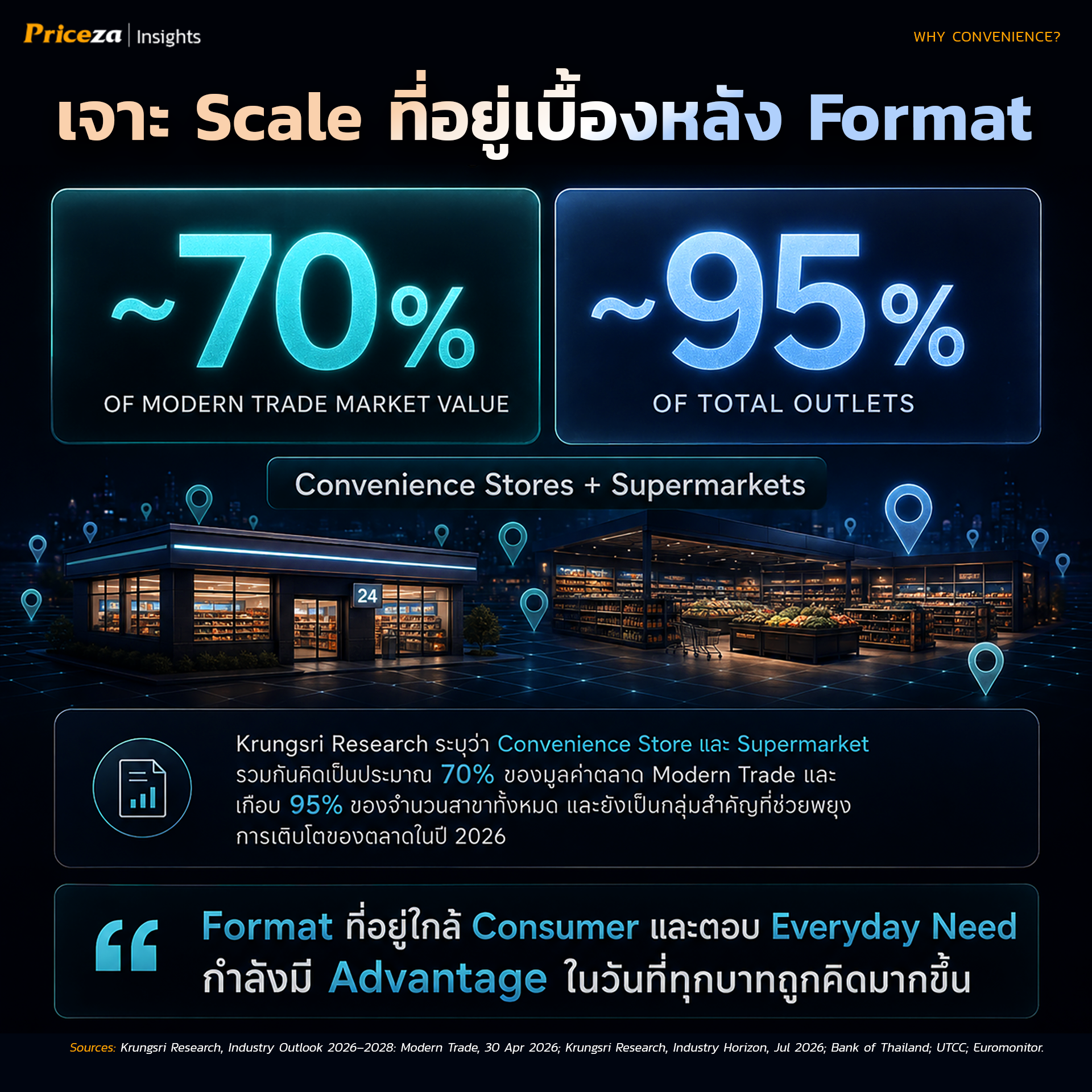
At the same time, the lines between formats are fading. Convenience stores are selling more fresh food and household goods, while supermarkets are downsizing into neighborhood stores to get closer to communities, and hypermarkets are focusing on services and omnichannel strategies.
Quick commerce is also capturing shopping missions that require urgent delivery. Therefore, future retail competition may no longer be clearly defined by the labels convenience, supermarket, or hypermarket, but rather by who can best fulfill the customer's shopping mission.
8. What brands and suppliers should rethink for Retail Thailand 2026
For brands, the growth of the convenience format doesn't just mean "getting into 7-Eleven." It means re-evaluating whether your product strategy aligns with convenience-based shopping missions.
1. Pack sizes must fit small baskets.
Products with an accessible entry price that don't require a high commitment may be better suited for a climate where consumers are more cautious with their spending.
2. Win with occasions, not just categories.
Customers might not be thinking, "What drink should I buy?" but rather, "Before work / After a workout / Late-night hunger / Need a quick breakfast." Brands that understand these occasions can launch products and promotions more effectively.
3. Ready-to-eat and immediate consumption are critical.
Products that offer "ready-to-eat or ready-to-use" convenience naturally align with the inherent advantages of this format.
4. Availability must be considered for both offline and online channels.
When a store becomes a fulfillment point, out-of-stock items don't just mean lost in-store sales; they can also lead to lost conversions from delivery orders.
5. Promotions must not erode margins entirely.
In a price-sensitive market, competing with promotions is essential, but brands must track contribution margins per SKU and per channel, rather than focusing solely on volume.
Priceza Insights View
The most interesting aspect of Thai retail in 2026 may not be that convenience stores are "winning" over other formats, but rather why they remain resilient while consumers are cautious with their spending. Consumers still need to eat, buy daily essentials, and fulfill needs throughout the day, but they want more control over their spending and aim to reduce time, distance, and hassle. This is causing retail competition to gradually shift from
Big Store → Right Store, Big Basket → Right Basket, Shopping Destination → Shopping Convenience and from Physical Store → Physical + Digital Fulfillment Network.
Therefore, for retailers and brands, the question in 2026 may no longer be just "Do we have enough branches or channels?" but rather "Can we be exactly where the customer wants to buy, at the time they want to buy, and with a basket size they are ready to pay for?"
Because in a market where purchasing power hasn't disappeared but is being used more cautiously, convenience is no longer just a retail format; it is becoming a competitive advantage.
FAQ
How much will Thailand's convenience store market grow in 2026?
Krungsri Research projects that convenience store and minimart revenue will grow by an average of approximately 4.5–5.2% per year during 2026–2028, which is higher than the forecasts for supermarkets, department stores, and hypermarkets during the same period.
How much will Thailand's modern trade grow in 2026?
In its July 2026 Industry Horizon report, Krungsri Research expects the overall modern trade sector to expand by approximately 2.0–2.5% in 2026, amid fragile purchasing power and a consumer focus on essential spending.
Why can convenience stores still grow when purchasing power is weak?
Key factors include the frequency of purchasing essential goods, proximity to consumers, smaller shopping baskets, ready-to-eat food, and the expansion of O2O/quick commerce, which increases both physical and digital reach.
Will convenience stores replace supermarkets or hypermarkets?
It is too early to conclude that, as each format serves different shopping missions. However, 2026 data indicates that behaviors focused on convenience, essential spending, and shopping close to home are helping convenience stores and supermarkets remain more resilient than other formats during periods of weak purchasing power.
Source / Methodology Note to be included at the end of the article
Sources: Krungsri Research – Industry Outlook 2026–2028: Modern Trade, published 30 April 2026; Krungsri Research – Industry Horizon, July 2026; Bank of Thailand Retail Sales Index; Euromonitor International – Convenience Retailers in Thailand, published 22 May 2026; CP ALL Q1/2026 Management Discussion and Analysis, published 13 May 2026.
Data Note: The figures 4.5–5.2%, 3.0–4.0%, 2.0–3.0%, and 1.2–2.2% represent the average revenue growth projected by Krungsri Research for the 2026–2028 period, not the actual growth for 2026. Meanwhile, the CP ALL data reflects the performance of a single company and is not representative of the entire convenience store market.


