
Summary: SEA E-Commerce 2026: Surging to $157.6B, but the market balance is shifting.
A deep dive into the Ecommerce in SEA 2026 report: With the Thai market surging by 51.8%, how should brands adjust their platform portfolios when the rules of the game are no longer measured by sales alone?


Integrate your CRM with other tools
Lorem ipsum dolor sit amet, consectetur adipiscing elit lobortis arcu enim urna adipiscing praesent velit viverra sit semper lorem eu cursus vel hendrerit elementum morbi curabitur etiam nibh justo, lorem aliquet donec sed sit mi dignissim at ante massa mattis.
- Neque sodales ut etiam sit amet nisl purus non tellus orci ac auctor
- Adipiscing elit ut aliquam purus sit amet viverra suspendisse potenti
- Mauris commodo quis imperdiet massa tincidunt nunc pulvinar
- Adipiscing elit ut aliquam purus sit amet viverra suspendisse potenti
How to connect your integrations to your CRM platform?
Vitae congue eu consequat ac felis placerat vestibulum lectus mauris ultrices cursus sit amet dictum sit amet justo donec enim diam porttitor lacus luctus accumsan tortor posuere praesent tristique magna sit amet purus gravida quis blandit turpis.

Techbit is the next-gen CRM platform designed for modern sales teams
At risus viverra adipiscing at in tellus integer feugiat nisl pretium fusce id velit ut tortor sagittis orci a scelerisque purus semper eget at lectus urna duis convallis. porta nibh venenatis cras sed felis eget neque laoreet suspendisse interdum consectetur libero id faucibus nisl donec pretium vulputate sapien nec sagittis aliquam nunc lobortis mattis aliquam faucibus purus in.
- Neque sodales ut etiam sit amet nisl purus non tellus orci ac auctor
- Adipiscing elit ut aliquam purus sit amet viverra suspendisse potenti venenatis
- Mauris commodo quis imperdiet massa at in tincidunt nunc pulvinar
- Adipiscing elit ut aliquam purus sit amet viverra suspendisse potenti consectetur
Why using the right CRM can make your team close more sales?
Nisi quis eleifend quam adipiscing vitae aliquet bibendum enim facilisis gravida neque. Velit euismod in pellentesque massa placerat volutpat lacus laoreet non curabitur gravida odio aenean sed adipiscing diam donec adipiscing tristique risus. amet est placerat.
“Nisi quis eleifend quam adipiscing vitae aliquet bibendum enim facilisis gravida neque velit euismod in pellentesque massa placerat.”
What other features would you like to see in our product?
Eget lorem dolor sed viverra ipsum nunc aliquet bibendum felis donec et odio pellentesque diam volutpat commodo sed egestas aliquam sem fringilla ut morbi tincidunt augue interdum velit euismod eu tincidunt tortor aliquam nulla facilisi aenean sed adipiscing diam donec adipiscing ut lectus arcu bibendum at varius vel pharetra nibh venenatis cras sed felis eget.
The e-commerce market in Southeast Asia is not slowing down as many had feared.
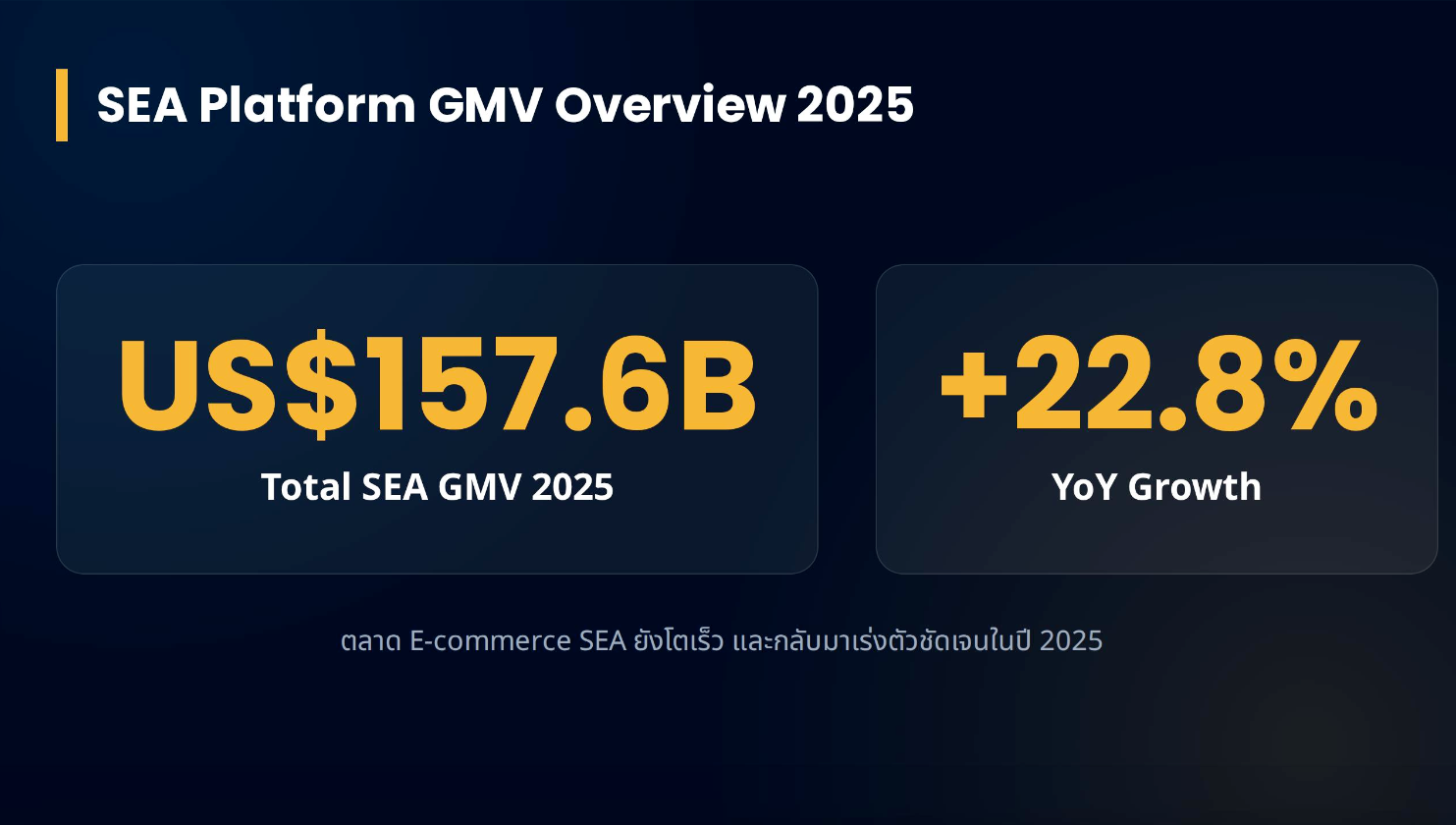
On the contrary, data from the Ecommerce in Southeast Asia 2026: Growth without equilibrium report shows that the region's platform e-commerce GMV in 2025 expanded to approximately US$157.6B, a growth of 22.8% YoY, and is nearly three times larger than in 2020.
But the key issue may not just be the question of
“Is the market still growing?”
Because the answer from the numbers is that the market is clearly still growing.
A more important question is,
“How is this growth changing the competitive structure of the ecosystem?”
As the market grows rapidly, major platforms play a larger role, and consumer behavior shifts from traditional product searches toward content, recommendations, and promotion-driven commerce, brands and sellers must view e-commerce through a lens that goes deeper than just “sales.”
1. SEA E-commerce is still growing strongly, but growth is not evenly distributed.
According to the report, the Southeast Asian platform e-commerce market has grown continuously from approximately US$54.2B in 2020 to US$157.6B in 2025
Interestingly, in 2025, the market accelerated again with a growth rate of 22.8% YoY, after the industry went through a post-COVID adjustment period regarding consumer behavior, platform operating costs, and profitability expectations.
Looking at individual countries, Indonesia remains the largest market in the region with a GMV of approximately US$57.7B, or about 37% of the total regional GMV.
However, the markets with the most outstanding growth are Thailand and Malaysia.
Thailand has a platform GMV of approximately US$35.5B and grew by 51.8% YoY, while Malaysia grew by 47.6% YoY, reflecting that both countries are becoming key areas for the next round of regional competition.
For Thailand, this growth figure does not just reflect increased demand; it also reflects the aggressive competition of major platforms in terms of promotions, logistics, content-commerce, affiliates, the creator economy, and customer experience, which are rapidly changing how Thai consumers shop.
2. Southeast Asia is becoming a “Three-Player Market.”
One of the clearest points from the report is that the Southeast Asian e-commerce market is becoming more consolidated, with three major regional player groups—Shopee, TikTok Shop, and Lazada—playing a crucial role in the market's direction.
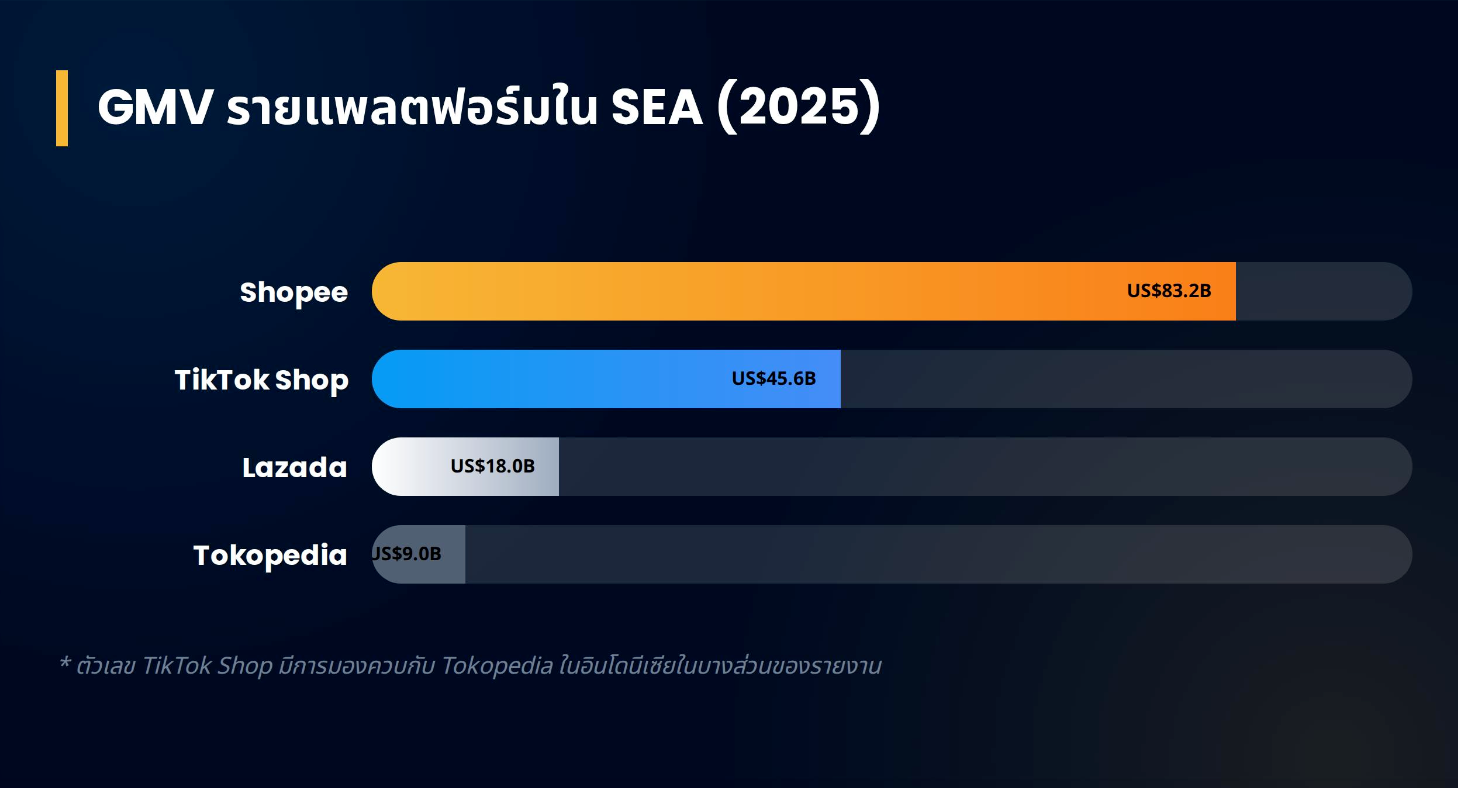
The report estimates that these three major platforms, when including TikTok Shop and Tokopedia in Indonesia, account for more than 98.8% of the platform e-commerce market in Southeast Asia.
In terms of 2025 GMV:
- Shopee remains the regional leader with a GMV of approximately US$83.2B
- TikTok Shop is growing rapidly with a GMV of approximately US$45.6B
- Lazada has a GMV of approximately US$18.0B
- while Tokopedia, which is under TikTok's control in Indonesia, has a GMV of approximately US$9.0B
If we combine TikTok Shop and Tokopedia, we can see that the TikTok group has a GMV equivalent to approximately 65.7% of Shopee at the regional level, reflecting the speed of expansion through content-commerce and social-driven shopping.
However, the competition in 2026 is no longer just about "who has the highest GMV," but rather a battle of distinct growth models.
Shopee remains strong as a marketplace with a complete ecosystem, including traffic, payments, logistics, and promotions.
TikTok Shop is expanding rapidly through the power of content, creators, livestreams, and discovery commerce.
Meanwhile, although Lazada’s regional GMV is lower than that of Shopee and TikTok Shop, reports indicate a strategic shift toward a brand-led and quality-focused approach, particularly in markets like Singapore, Thailand, and the Philippines. This reflects that competition is not just about GMV volume, but also customer quality, average order value, and brand experience.
In other words, the market is no longer just a competition between marketplaces; it is becoming a competition between platform ecosystems that play different roles in the customer journey.
3. Thailand has become one of the region's key battlegrounds.
For Thailand, the report estimates the 2025 Platform GMV at approximately US$35.5B, a growth of 51.8% YoY, which is among the highest growth rates in the region.
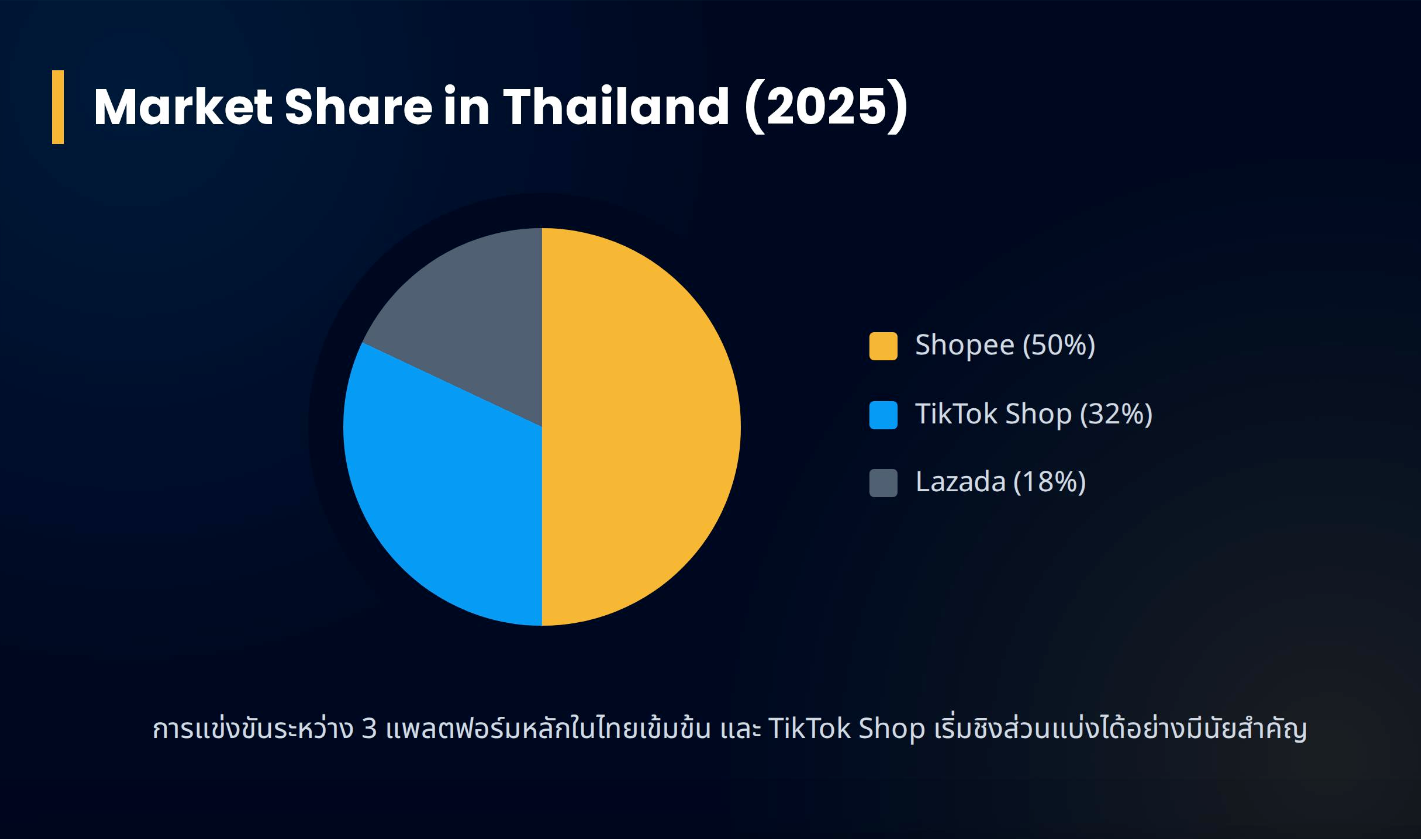
The structure of the Thai market in 2025 is estimated as follows:
- Shopee holds a share of approximately 50%
- , TikTok Shop approximately 32%
- , and Lazada approximately 18%
These figures reflect a very important picture for brands and sellers in Thailand.
The Thai market is no longer just a traditional marketplace; it is a market where consumers engage in multiple behaviors simultaneously—from searching for products, comparing prices, and reading reviews to making decisions based on content, purchasing via livestreams, and responding to real-time promotions.
Therefore, doing e-commerce in Thailand in 2026 is not just about "listing products on every platform," but about gaining a clearer understanding of each platform's role in the customer journey.
For some products, Shopee may be a strong channel for conversion and mass reach.
For some brands, Lazada may better serve needs related to brand experience, trust, and quality-conscious customers.
Meanwhile, TikTok Shop may be a vital tool for generating new demand through content and creators.
Competition, therefore, does not lie in choosing just one platform, but in designing a platform portfolio that suits your products, customers, margins, and business growth goals.
4. As platforms grow, the role of brands must evolve accordingly.
The fact that the market is trending toward consolidation does not mean there is no room for brands or SMEs to grow.
On the contrary, large platforms play a crucial role in building market infrastructure, including traffic, payments, logistics, customer trust, promotion tools, and service standards that help make e-commerce more accessible to a wider range of consumers.
However, on the other hand, brands can no longer view platforms merely as "sales channels."
What is interesting is that the growth of major players reflects not only sales competition but also the shift in the platform's role from a "trading space" to a "growth infrastructure" that covers everything from product discovery, demand generation, payments, and logistics to post-purchase experience.
For brands and sellers, this means that e-commerce in 2026 must move beyond platform listing or campaign-based selling toward clearly designing the role of each platform within the customer journey.
Brands must therefore start asking new questions, such as:
- Which platform is best for building awareness?
- Which platform is best for closing sales?
- Which platform is best for establishing brand credibility?
- Which platform generates new customers, but at a higher cost than expected?
- And what role should a brand’s own channels play in maintaining long-term customer relationships?
This marks a shift from the mindset of "selling wherever there is traffic" to "designing a sales ecosystem tailored for profitability and business growth."
5. What This Means for Brands in 2026
This report is not just relevant to platforms; it has direct implications for brands, sellers, and SMEs as they plan their e-commerce strategies for 2026.
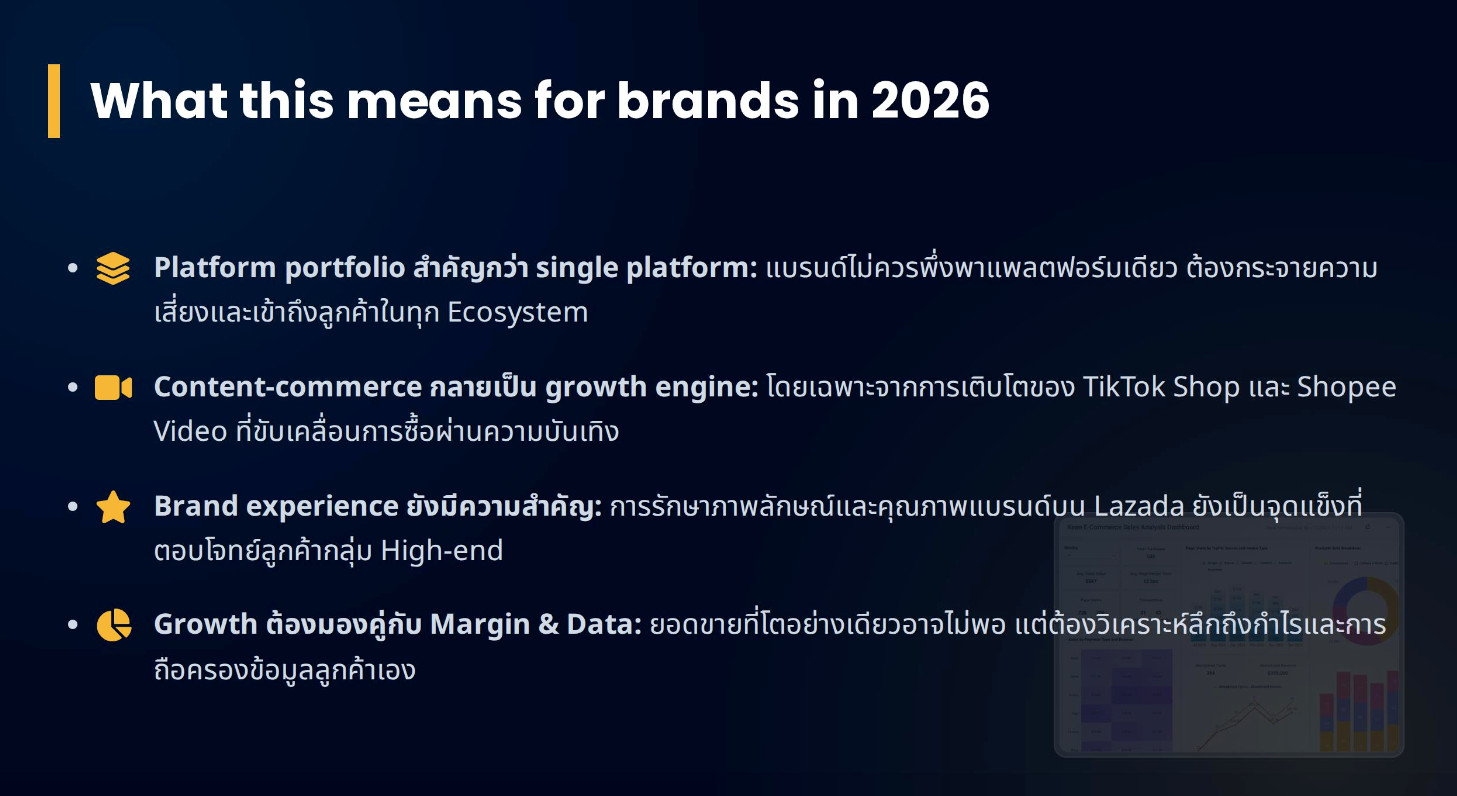
1. A Platform Portfolio is More Important Than a Single Platform
In an era where consumer behavior is fragmented across multiple channels, brands should not rely too heavily on any single platform, but rather define a clear role for each one.
Some platforms may be suited for volume,
some for brand building,
some for content-led discovery,
and some for long-term customer retention.
2. Content-Commerce Has Become a Key Growth Engine
The rapid growth of TikTok Shop reflects that content is no longer just a tool for building awareness; it is becoming an integral part of the transaction journey.
Content, reviews, live streams, and creators are no longer just media assets; they are demand-generation engines that can lead directly to sales.
3. There is Still Room to Compete on Brand Experience
Lazada’s brand-led and quality-focused direction shows that e-commerce competition is about more than just price and promotions.
For products that require high credibility, have a high average order value, or are sensitive to brand image, customer experience, confidence, and channel reliability remain critical factors.
4. Margin and Data Ownership Must Be Considered from the Start
As the market grows faster, competition for traffic and promotions intensifies accordingly.
Brands must look beyond total sales and focus on gross margin, take rates, repeat purchases, customer data, and lifetime value.
Sustainable growth in 2026 is not just about selling more; it is about growing while maintaining profitability, customer relationships, and the data necessary for long-term decision-making.
6. Growth without equilibrium: Growing faster, but the new balance is still adjusting
The term Growth without equilibrium offers an intriguing snapshot of the Southeast Asian e-commerce landscape.
The market continues to grow,
consumers are spending more on digital channels,
major platforms are expanding their roles,
and new technologies are making commerce more efficient.
At the same time, however, the balance between platforms, sellers, brands, and consumers is still in a state of adjustment.
For platforms, the challenge lies in driving growth while ensuring profitability and maintaining the quality of the ecosystem.
For brands, the challenge is to leverage platforms to their full potential without neglecting margins, data, and customer relationships.
For SMEs, the challenge is to use platforms as a growth tool without becoming overly dependent on any single channel.
E-commerce in 2026 is no longer just a game of "selling as much as possible," but a game of designing a more balanced growth system.
Key takeaways from Priceza Insights
The report Ecommerce in Southeast Asia 2026: Growth without equilibrium highlights that Southeast Asia remains one of the most dynamic e-commerce markets in the world.
Yet, this market growth is accompanied by a shifting competitive landscape.
From a more fragmented market to one where major platforms play a central role.
From marketplaces focused on listings and promotions to ecosystems that integrate content, commerce, logistics, payments, and customer experience.
From measuring success solely by GMV to focusing on long-term profitability, data, and customer relationships.
For Thailand, the over 50% GMV growth in 2025 signals that significant opportunities remain, but these opportunities come with increased complexity.
The brands and sellers that win in 2026 may not be those present on every platform,
but rather those who understand the specific role each platform should play in their growth strategy.
Because in a market that is growing faster but lacks equilibrium,
the advantage will go to businesses that can "read the game" and design strategies faster than the rest.
Note: Figures in this article are based on the Ecommerce in Southeast Asia 2026: Growth without equilibrium report by Momentum Works. GMV estimates are in USD and may be affected by exchange rates, calculation methodologies, and data scope. In some parts of the report, regional TikTok Shop figures include Tokopedia in Indonesia, reflecting the growing role of the TikTok group in the Southeast Asian e-commerce market.


